Distributed Transaction Handling
What is a Transaction
Section titled “What is a Transaction”- A transaction is a group of operations executed as a single unit, ensuring data integrity and consistency.
- Key Principle: All or Nothing - if any operation fails, the entire transaction is rolled back.
- Example: Transferring money:
- Debit from
Person Aand credit toPerson B. If any step fails, rollback the entire transaction.
- Debit from
- ACID Properties ensure reliability in transactions.
Monolithic Architecture: Transaction Management
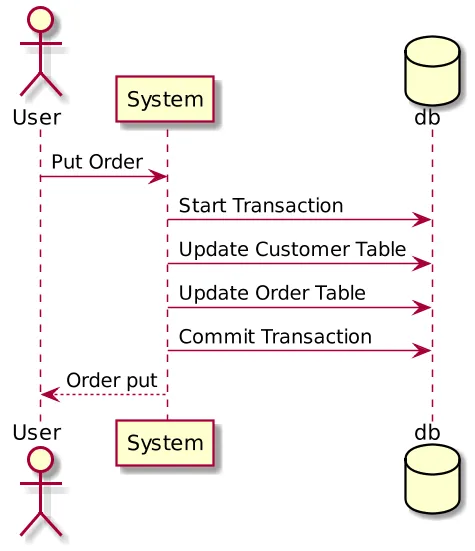
Section titled “Monolithic Architecture: Transaction Management”Definition: A single, unified application where all components (database, business logic, UI) are tightly integrated.
-
Transaction Process:
- Inventory Check and Update
- Payment Processing
- Order Recording
-
Key Point: All steps occur in a single database transaction, ensuring ACID properties.
-
Advantage: Simple transaction management due to centralized data.
Microservices Architecture: Transaction Management
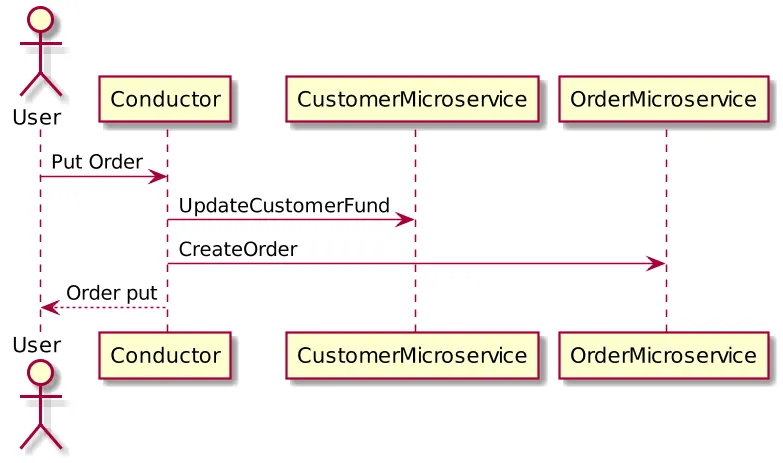
Section titled “Microservices Architecture: Transaction Management”Definition: Independent services, each with its own data store, coordinating through APIs and events.
-
Transaction Process:
- Inventory Service: Checks and updates stock.
- Payment Service: Processes payment.
- Order Service: Records the order.
-
Key Point: Transactions span multiple services and databases, requiring compensating actions for failures.
-
Challenge: Complex transaction management due to distributed nature.
| Architecture | Transaction Scope | Complexity |
|---|---|---|
| Monolithic | Single database, ACID guaranteed | Simple |
| Microservices | Multiple databases, requires coordination | Complex |
What is a Distributed Transaction?
Section titled “What is a Distributed Transaction?”- A transaction that spans multiple services and databases in a microservices architecture.
Solutions for Microservice Transactions
Section titled “Solutions for Microservice Transactions”Two-Phase Commit (2PC)
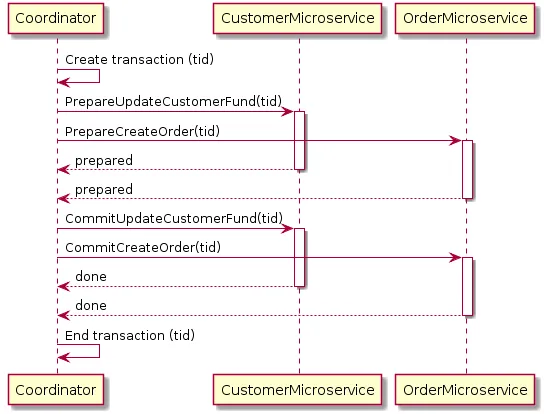
Section titled “Two-Phase Commit (2PC)”A protocol ensuring all services agree to commit or roll back changes together.
Phases
Section titled “Phases”- Prepare Phase: Coordinator asks all services to prepare (lock resources and verify readiness)
- Commit Phase: If all services respond “ready”, coordinator commits; otherwise, rolls back
Rollback Scenario
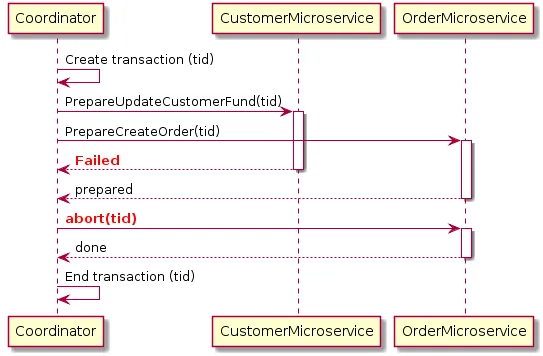
Section titled “Rollback Scenario”When any service fails during prepare or commit:
- Coordinator detects the failure
- Sends rollback request to all participants
- Each participant undoes prepared changes
- Transaction aborts and client is notified
Pros and Cons
Section titled “Pros and Cons”| Pros | Cons |
|---|---|
| Strong consistency | Blocking (participants wait for coordinator) |
| Atomic guarantees | Single point of failure |
| Simple mental model | Complex failure recovery |
SAGA Pattern
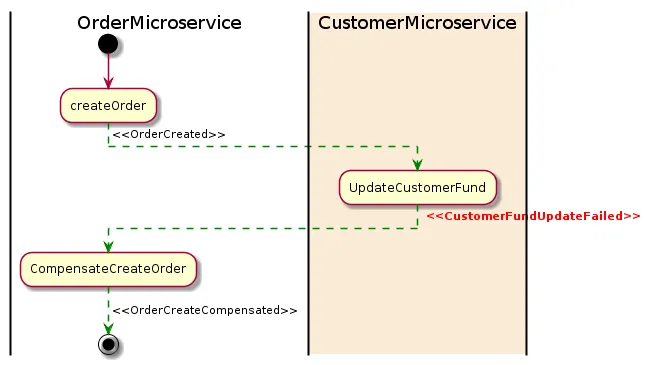
Section titled “SAGA Pattern”A series of local transactions with compensating actions to undo changes on failure. Focuses on eventual consistency rather than strong consistency.
How It Works
Section titled “How It Works”- Each service performs its local transaction and emits an event
- Next service listens, processes, and emits its own event
- On failure, compensating transactions revert previous changes
Example: Order Service creates order → emits “OrderCreated” → Payment Service processes payment → emits “PaymentBilled” → if Payment fails, Order Service reverts the order.
SAGA Types
Section titled “SAGA Types”Choreography-Based
Section titled “Choreography-Based”No central orchestrator. Services communicate via events directly.
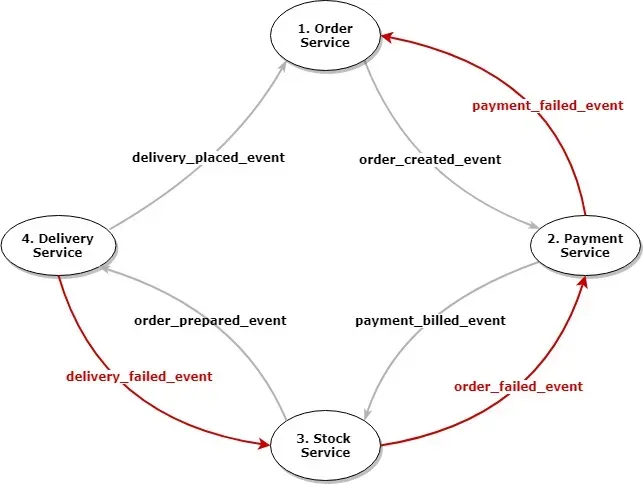
| Pros | Cons |
|---|---|
| Decentralized and scalable | Complex event management |
| No single point of failure | Hard to track transaction state |
| Good for simple workflows | Debugging is challenging |
Orchestration-Based
Section titled “Orchestration-Based”A central orchestrator manages the transaction flow and rollbacks.
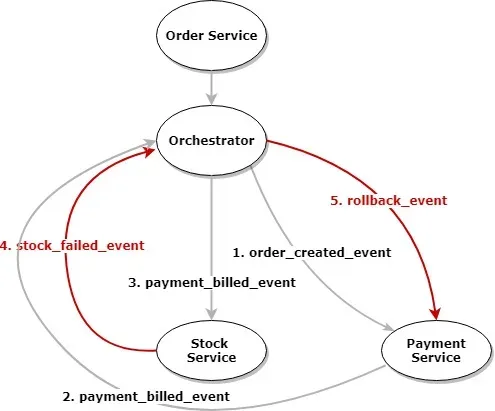
| Pros | Cons |
|---|---|
| Centralized control | Single point of failure |
| Easier to manage and debug | Orchestrator can become bottleneck |
| Clear transaction visibility | Requires orchestrator infrastructure |
2PC vs SAGA Comparison
Section titled “2PC vs SAGA Comparison”| Aspect | 2PC | SAGA |
|---|---|---|
| Coordination | Centralized coordinator | Choreography (decentralized) or Orchestration (centralized) |
| Communication | Synchronous | Asynchronous |
| Consistency | Strong (ACID) | Eventual |
| Performance | Slower (blocking) | Faster (non-blocking) |
| Failure Handling | Rollback all | Compensating transactions |
| Best For | Short transactions, few participants | Long-running, complex workflows |
When to Use What
Section titled “When to Use What”| Scenario | Recommended Pattern |
|---|---|
| Financial transactions requiring atomicity | 2PC |
| E-commerce order with multiple services | SAGA (Orchestration) |
| Event-driven microservices | SAGA (Choreography) |
| Cross-database transactions in same region | 2PC |
| Geo-distributed services | SAGA |
- 2PC: Strong consistency through blocking coordination. Use when atomicity is critical and participants are few.
- SAGA: Eventual consistency through compensating actions. Use for long-running, complex distributed workflows.
- Choose based on consistency requirements vs. availability and performance needs.