
DBMS Fundamentals
DBMS Architecture
Section titled “DBMS Architecture”A DBMS provides query parsing, optimization, storage management, concurrency control, and recovery—all abstracted from the application layer.
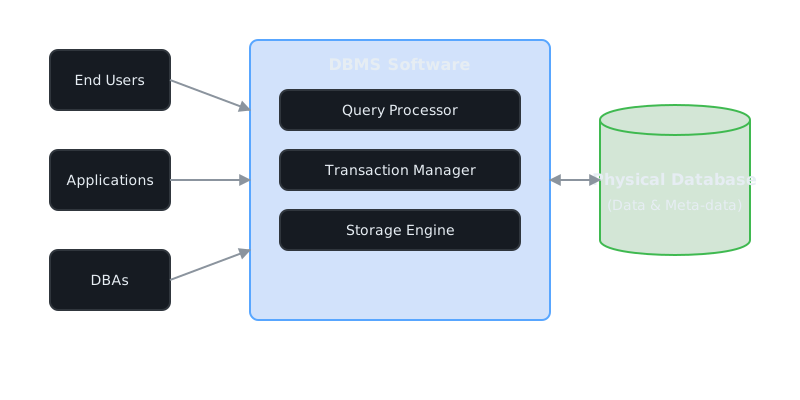
Key responsibilities: Query optimization, buffer management, lock management, WAL/recovery, access control.
Data Models
Section titled “Data Models”| Model | Structure | Examples | Trade-offs |
|---|---|---|---|
| Relational | Tables + SQL | PostgreSQL, MySQL, Oracle, SQL Server | ACID guarantees, mature tooling, vertical scaling limits |
| Document | JSON/BSON docs | MongoDB, CouchDB, Firestore | Schema flexibility, denormalized reads, weaker consistency |
| Key-Value | Hash map | Redis, DynamoDB, etcd, Memcached | O(1) lookups, no range queries, limited querying |
| Wide-Column | Column families | Cassandra, HBase, ScyllaDB | Write-optimized, time-series friendly, complex data modeling |
| Graph | Nodes + Edges | Neo4j, Amazon Neptune, ArangoDB | Relationship traversal, poor for non-graph workloads |
ER Modeling
Section titled “ER Modeling”ER diagrams translate business requirements into schema design. Key mappings:
| ER Concept | RDBMS Implementation |
|---|---|
| Entity | Table |
| Attribute | Column |
| Relationship | FK or junction table |
Cardinality Patterns
Section titled “Cardinality Patterns”| Type | Implementation | Watch out for |
|---|---|---|
| 1:1 | FK with UNIQUE on either side | Often indicates table can be merged |
| 1:N | FK on the “many” side | Index the FK column |
| M:N | Junction table with composite PK | Can become a bottleneck; consider denormalization |
Attribute Types
Section titled “Attribute Types”- Derived: Compute at read-time or materialize with triggers/generated columns
- Multivalued: Normalize into separate table or use array types (Postgres
[]) - Composite: Flatten into columns or use structured types (JSONB)
Data Integrity
Section titled “Data Integrity”| Constraint | Enforcement | Operational Impact |
|---|---|---|
PRIMARY KEY | Unique + NOT NULL | Clustered index in most engines |
FOREIGN KEY | Referential checks | Write overhead; consider DEFERRABLE for bulk loads |
CHECK | Domain validation | Executed per-row; keep simple |
UNIQUE | Prevents duplicates | Creates index; NULLs typically allowed |
| Triggers | Custom logic | Hidden complexity; prefer app-layer when possible |
| Key Type | Definition | Usage Notes |
|---|---|---|
| Primary | Unique row identifier | Immutable, indexed, one per table |
| Candidate | Columns that could be PK | Minimal set guaranteeing uniqueness |
| Composite | Multi-column PK | Common in junction tables |
| Foreign | Reference to another table’s PK | Index for join performance |
| Unique | Uniqueness without PK semantics | Allows NULLs (behavior varies by engine) |
Surrogate vs. Natural Keys
Section titled “Surrogate vs. Natural Keys”| Aspect | Surrogate (UUID/Auto-inc) | Natural (email, SKU) |
|---|---|---|
| Stability | Immutable | May change → cascading updates |
| Size | Fixed (8B int, 16B UUID) | Variable |
| Indexing | Predictable | Can be suboptimal |
| Debugging | Opaque | Human-readable |
Recommendation: Use surrogates for PKs; enforce natural keys via UNIQUE constraints.
Transactions & ACID
Section titled “Transactions & ACID”| Property | Guarantee | Implementation |
|---|---|---|
| Atomicity | All-or-nothing | WAL + rollback segments |
| Consistency | Constraints honored | Constraint checks at commit |
| Isolation | Concurrent txn separation | Locking or MVCC |
| Durability | Survives crashes | WAL fsync before commit |
Isolation Levels (Weakest → Strongest)
Section titled “Isolation Levels (Weakest → Strongest)”| Level | Phenomena Allowed | Use Case |
|---|---|---|
| Read Uncommitted | Dirty reads | Almost never appropriate |
| Read Committed | Non-repeatable reads | Default in Postgres, Oracle |
| Repeatable Read | Phantom reads | Default in MySQL InnoDB |
| Serializable | None | Financial transactions, inventory |
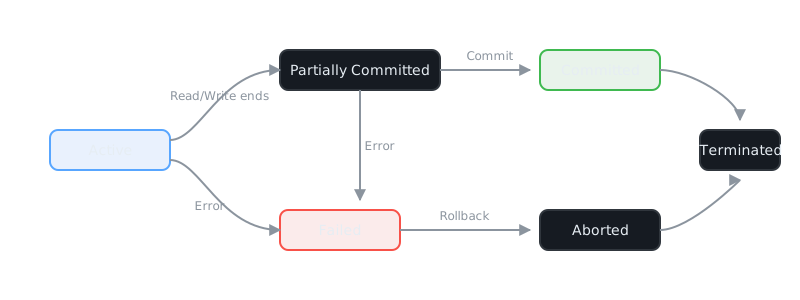
Performance vs. Correctness
Higher isolation = more locking/aborts. Profile your workload. Many “Serializable” requirements can be relaxed with careful schema design or optimistic locking at the app layer.