Consistent Hashing
Terminology
Section titled “Terminology”- Node: a server that provides functionality to other services.
- Hash function: maps data of arbitrary size to fixed-size values.
- Data partitioning: distributes data across multiple nodes to improve performance and scalability.
- Data replication: stores multiple copies of the same data on different nodes to improve availability and durability.
- Hotspot: a performance‑degraded node due to a large share of data and high request volume.
Requirements
Section titled “Requirements”- Minimise hotspots.
- Handle Internet‑scale, dynamic load.
- Minimise data movement when nodes join/leave.
Why Consistent Hashing?
Section titled “Why Consistent Hashing?”Popular sites can spike in traffic quickly. Caches reduce load/latency, but the cache tier must scale elastically. A fixed pool of cache servers can’t keep up with dynamic demand. Consistent hashing lets us scale the cache tier up/down while moving only a small fraction of keys.
Replication vs. Sharding (Partitioning)
Section titled “Replication vs. Sharding (Partitioning)”Replication
Section titled “Replication”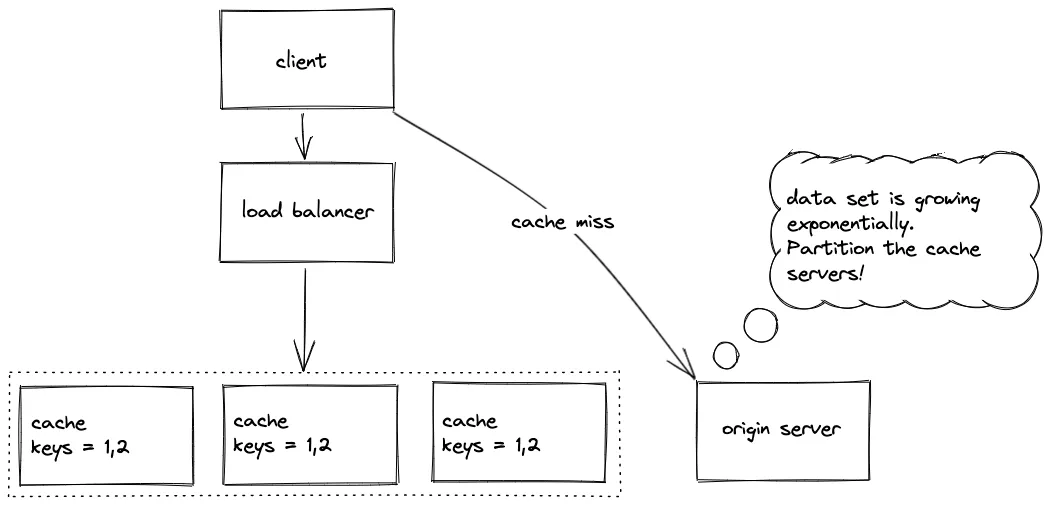
Replication improves availability and read throughput, but does not on its own solve dynamic load because only a limited subset of data can be cached and keeping replicas strongly consistent is costly.
Problems
- Limited cacheable dataset.
- Maintaining consistency between replicas is expensive.
Sharding (Partitioning)
Section titled “Sharding (Partitioning)”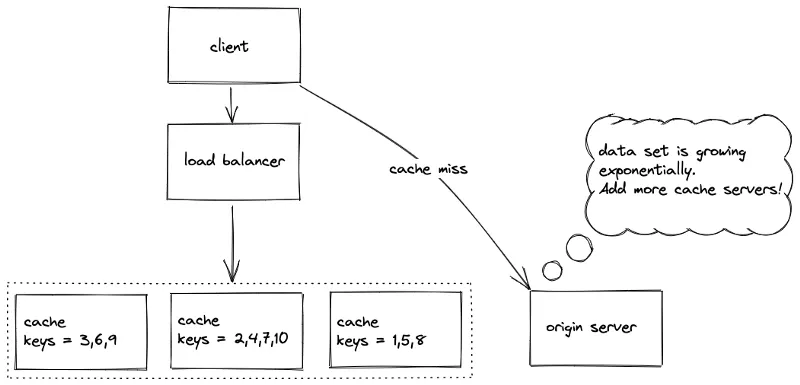
Sharding is how we scale horizontally. Data is split across nodes; replication is orthogonal (you can shard and replicate). Multiple shards can live on one node to improve fault tolerance and throughput.
Reasons to shard
- Cache servers are memory‑bound.
- Higher parallelism → higher throughput.
Partitioning Approaches (Quick Compare)
Section titled “Partitioning Approaches (Quick Compare)”-
Random Assignment
- ✅ Simple.
- ❌ Uncontrolled distribution → hotspots likely.
-
Single Global Cache
- ✅ Easy to manage for tiny datasets.
- ❌ Scalability bottleneck & single point of failure.
-
Key Range Partitioning
- ✅ Efficient range queries.
- ❌ Skewed ranges create hotspots; hard to rebalance as data evolves.
-
Static Hash Partitioning (mod N)
- ✅ Deterministic, balances typical loads.
- ❌ When N changes (nodes join/leave), almost all keys move (rehash to new mod), causing churn.
Takeaway: Hashing is great for balance; consistent hashing fixes the “mod N changes” churn problem.
Consistent Hashing (What & How)
Section titled “Consistent Hashing (What & How)”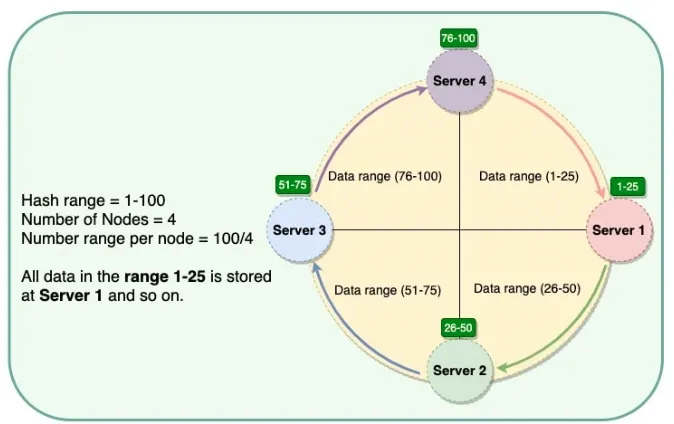
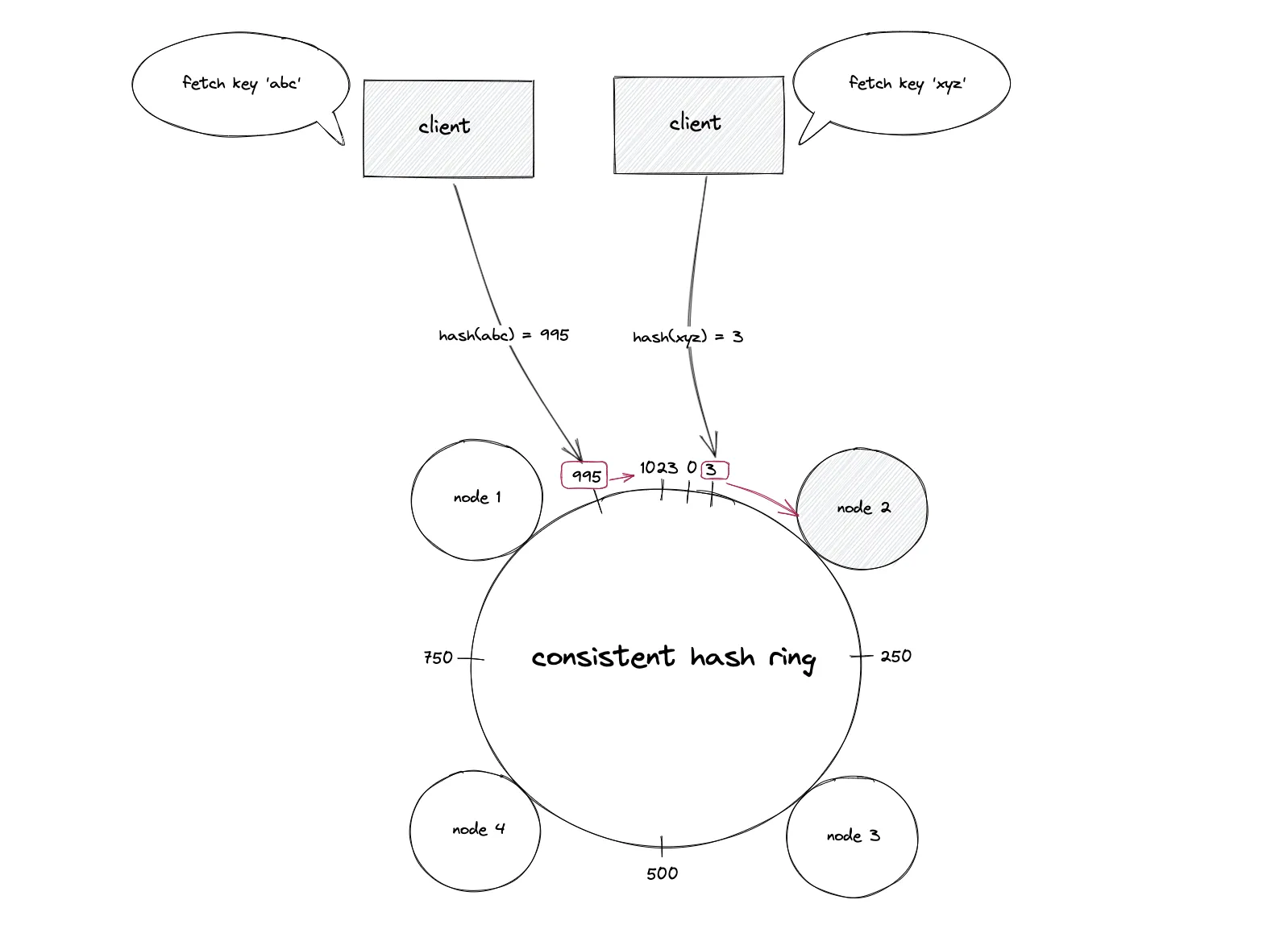
Idea: Place both nodes and keys on a circular hash ring (0…2^m−1). A key belongs to the first node clockwise from its hash position. When nodes join/leave, only keys on the affected arcs move.
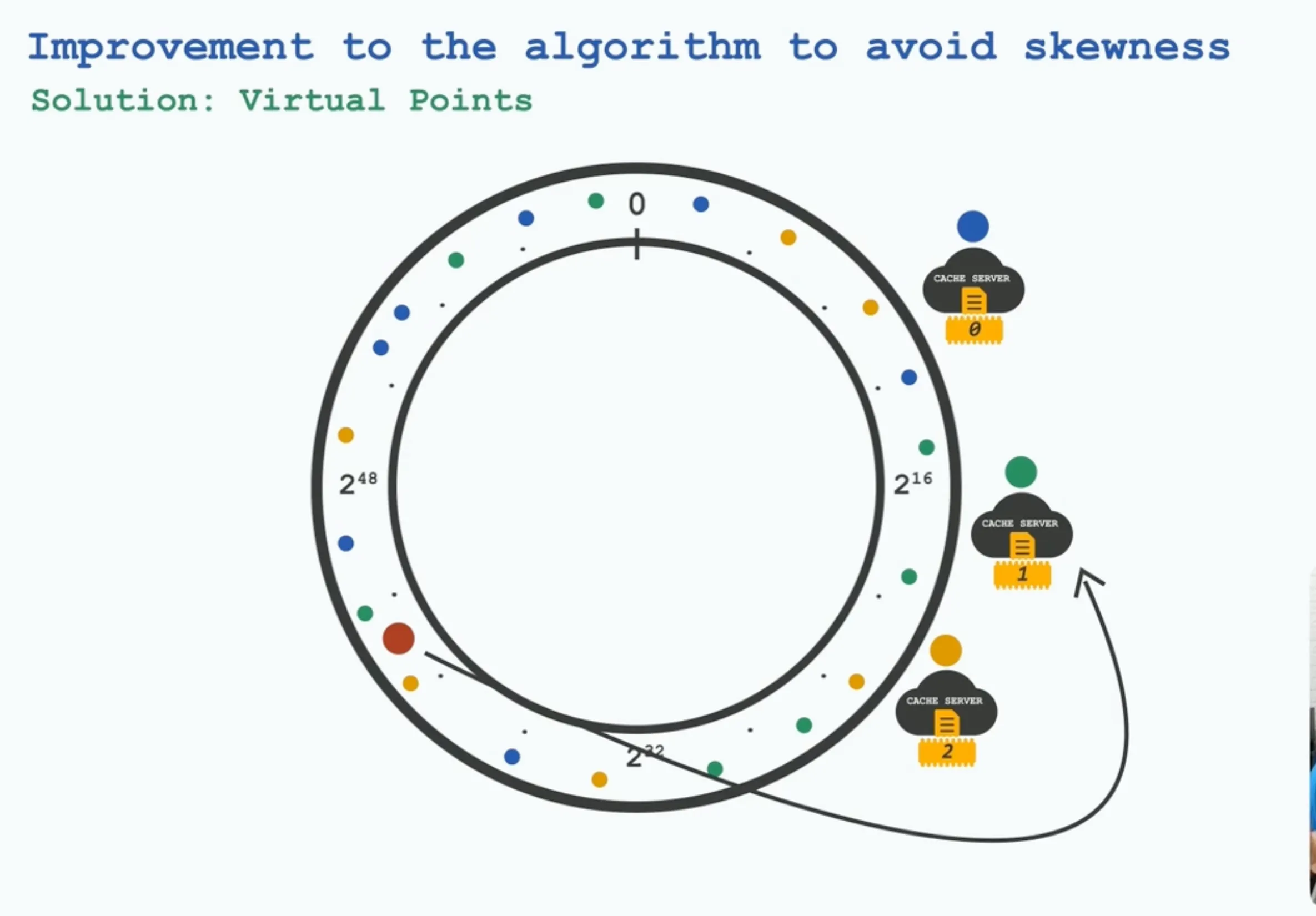
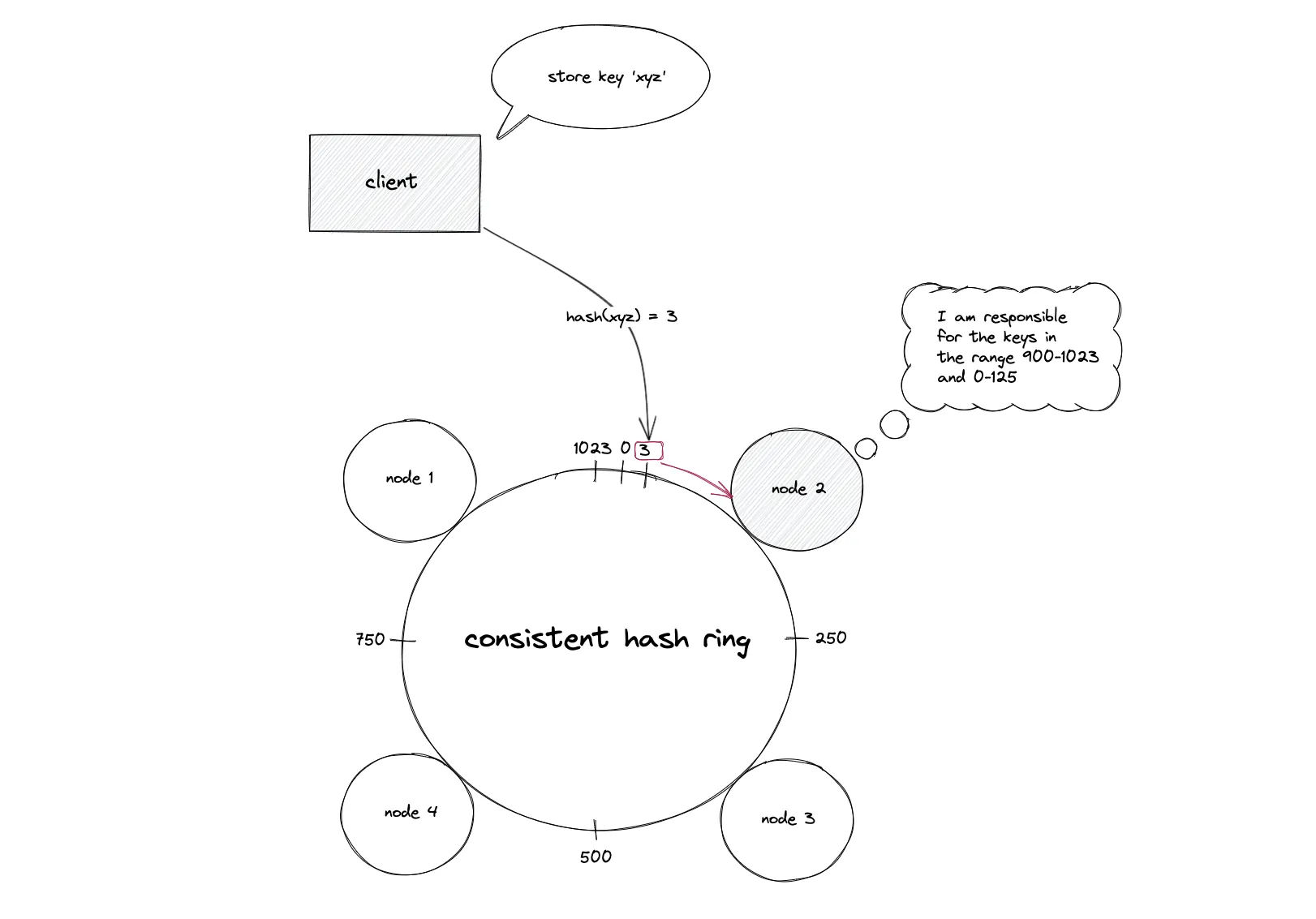
Lookup: Hash the key → walk clockwise to the successor node.
Data structure: Keep node positions in an ordered map (e.g., self‑balancing BST / TreeMap). Search/insert/delete are O(log N).
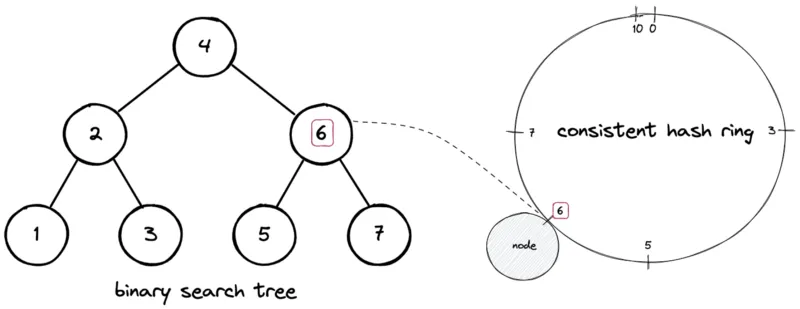
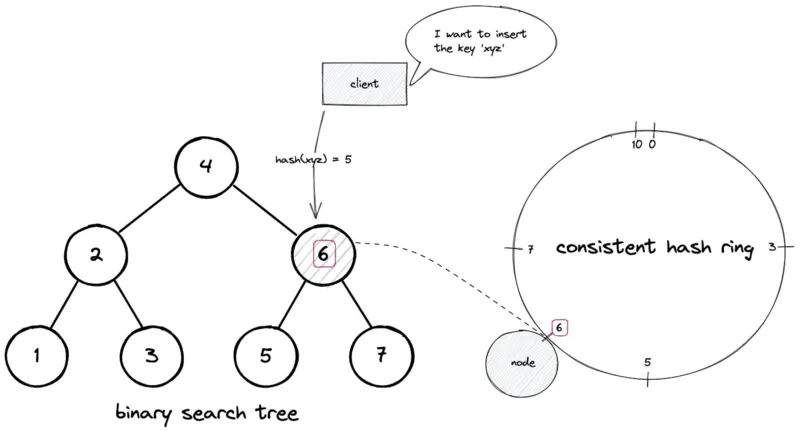
Example: key xyz hashes to 5 → successor node is at position 6 → store on node at 6.
Operations
Section titled “Operations”- Insertion
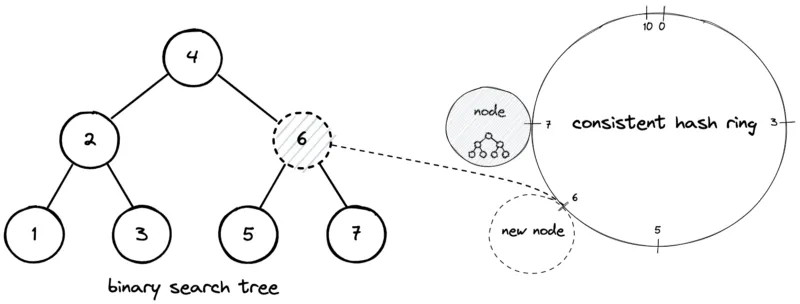
Steps: hash(key) → successor(node) in the ring → store.
- Deletion
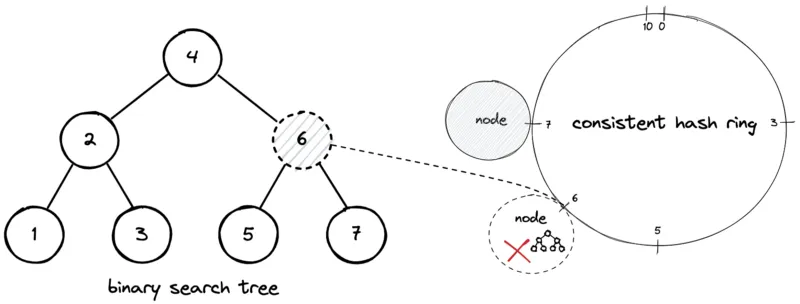
When a node leaves, only the keys it owned move to the next clockwise node.
Why it meets the requirements
Section titled “Why it meets the requirements”- Scalable: distributes keys over many nodes.
- Low movement: only nearby keys remap on membership change.
- Hotspot mitigation: use virtual nodes and weights; add capacity by adding nodes or increasing a node’s weight (more virtual nodes) without reshuffling everything.
Practical Tips
Section titled “Practical Tips”- Virtual Nodes (VNodes): insert each physical node multiple times on the ring to smooth distribution.
- Weighted nodes: more vnodes for stronger machines.
- Replication on the ring: place each key on the next R distinct nodes clockwise to improve availability.
- Hash choice: a uniform, fast hash (Murmur3, xxHash). For simplicity in demos,
String.hashCode()is fine; in prod, prefer a better hash. - Failure handling: on node failure, keys fall through to the next successor automatically.
- Monitoring: watch key/traffic distribution; consider adaptive weights if skew emerges.
Complexity
Section titled “Complexity”- Add/Remove Node: O(V log N) where V = virtual nodes for that machine.
- Lookup (getNode): O(log N).
- Movement on change: ~O(K/N) keys move (K = total keys, N = nodes).
Java Code (Simpler & Clearer)
Section titled “Java Code (Simpler & Clearer)”A small, generic implementation using TreeMap and optional replication. It keeps the original spirit, adds clear comments, and makes VIRTUAL_NODES configurable. The hash is kept simple for readability; swap it with a stronger hash if needed.
import java.util.*;
class ConsistentHashing {    private final TreeMap<Integer, String> ring = new TreeMap<>();    private final int VIRTUAL_NODES = 3;  // Virtual nodes to balance the distribution    private final int HASH_SPACE = Integer.MAX_VALUE;  // 32-bit hash space
    private int hash(String key) {        return key.hashCode() & HASH_SPACE;  // Simple hash function    }
    public void addNode(String node) {        for (int i = 0; i < VIRTUAL_NODES; i++) {            int hash = hash(node + i);            ring.put(hash, node);            System.out.println("Added node " + node + " with hash " + hash);        }    }
    public void removeNode(String node) {        for (int i = 0; i < VIRTUAL_NODES; i++) {            int hash = hash(node + i);            ring.remove(hash);            System.out.println("Removed node " + node + " with hash " + hash);        }    }
    public String getNode(String key) {        if (ring.isEmpty()) return null;        int keyHash = hash(key);        // Find the next node in the hash ring (circular behavior)        Map.Entry<Integer, String> entry = ring.ceilingEntry(keyHash);        if (entry == null) {            return ring.firstEntry().getValue();  // Wrap around to the first node        }        return entry.getValue();    }
    public void printRing() {        System.out.println("Hash Ring: " + ring);    }
    public static void main(String[] args) {        ConsistentHashing ch = new ConsistentHashing();
        // Adding nodes        ch.addNode("Node1");        ch.addNode("Node2");        ch.addNode("Node3");
        ch.printRing();
        // Mapping some keys        System.out.println("Key 'Apple' is assigned to " + ch.getNode("Apple"));        System.out.println("Key 'Banana' is assigned to " + ch.getNode("Banana"));
        // Removing a node        ch.removeNode("Node2");
        ch.printRing();
        // Checking mapping after removal        System.out.println("Key 'Apple' is now assigned to " + ch.getNode("Apple"));        System.out.println("Key 'Banana' is now assigned to " + ch.getNode("Banana"));    }}