
Caching
What Caching Solves
Section titled “What Caching Solves”Caching stores hot data in faster storage (memory/edge) so systems can:
- reduce read latency,
- protect databases/services from repeated reads,
- increase throughput with the same backend capacity.
Caching is a performance optimization layer, not the source of truth.
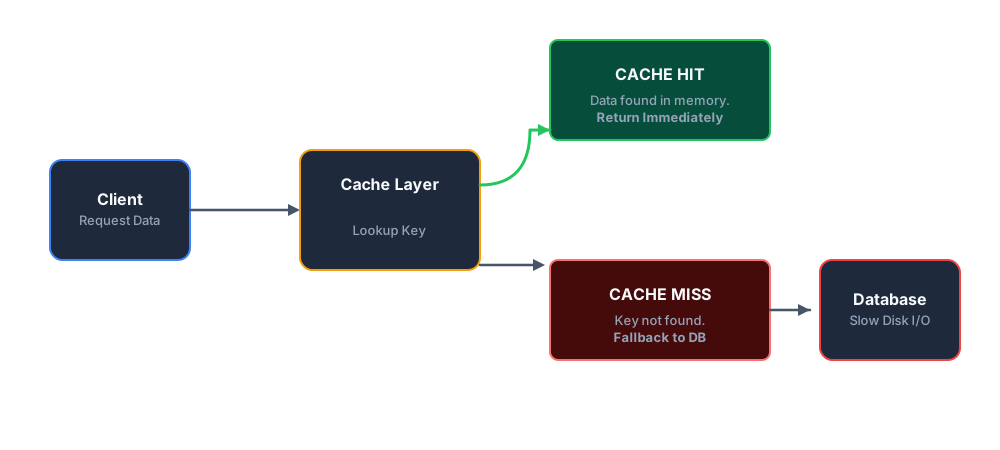
Basic Read Path
Section titled “Basic Read Path”- Client requests data.
- Cache lookup:
- Hit -> return immediately.
- Miss -> read from source, populate cache, return.
- Eviction policy decides what remains when capacity is full.
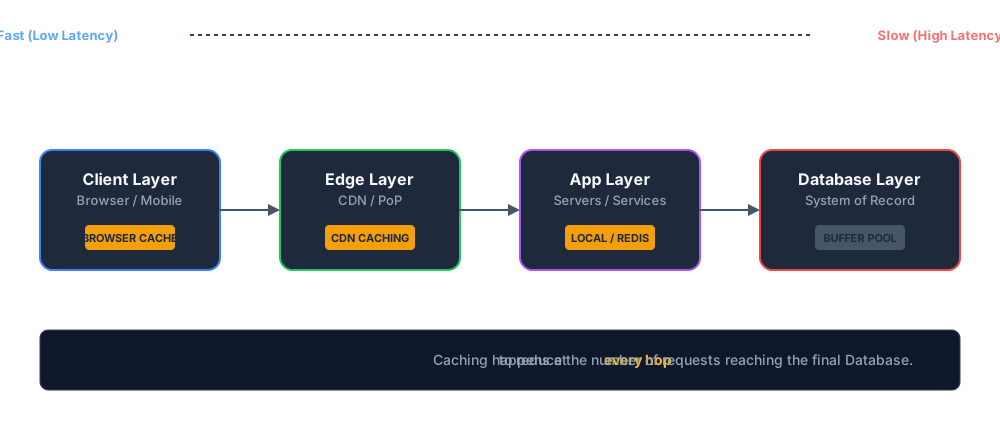
Where Caching Appears
Section titled “Where Caching Appears”- Client/browser cache: static assets and API responses.
- CDN/edge cache: geo-distributed static delivery.
- Application cache: object/query/result caching near app tier.
- Database cache/buffer pool: page/block-level acceleration.
- DNS cache: domain resolution reuse.
What to Cache
Section titled “What to Cache”Best candidates:
- read-heavy data,
- expensive-to-compute responses,
- slow remote lookups,
- data with acceptable staleness window.
Avoid caching:
- highly volatile or strictly real-time data without strong invalidation controls,
- low-reuse keys that pollute cache.
Eviction Policies
Section titled “Eviction Policies”| Policy | Best for | Trade-off |
|---|---|---|
| LRU | Temporal locality | May evict frequent older items |
| LFU | Stable popularity patterns | Extra frequency metadata |
| FIFO | Simplicity | Ignores access behavior |
| TTL-based | Freshness control | Sensitive to wrong TTL values |
| Random | Very low overhead | Unpredictable quality |
Freshness and Invalidation
Section titled “Freshness and Invalidation”Caching correctness depends on invalidation strategy:
- TTL expiry,
- explicit delete/update on writes,
- versioned keys,
- event-driven invalidation.
How reads and writes coordinate with the cache is covered in Caching Strategies below.
Caching Strategies
Section titled “Caching Strategies”Caching strategies define how data is read into cache, how writes reach cache and the source of truth, and how consistency, latency, and durability trade off.
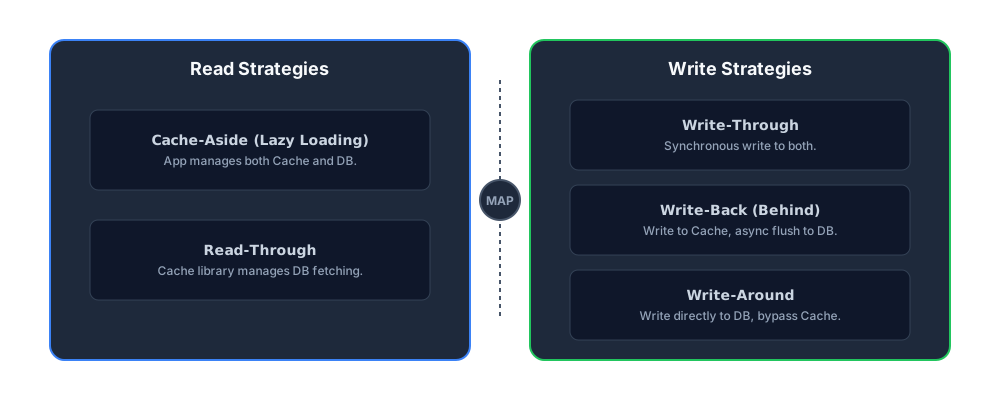
Read Strategies
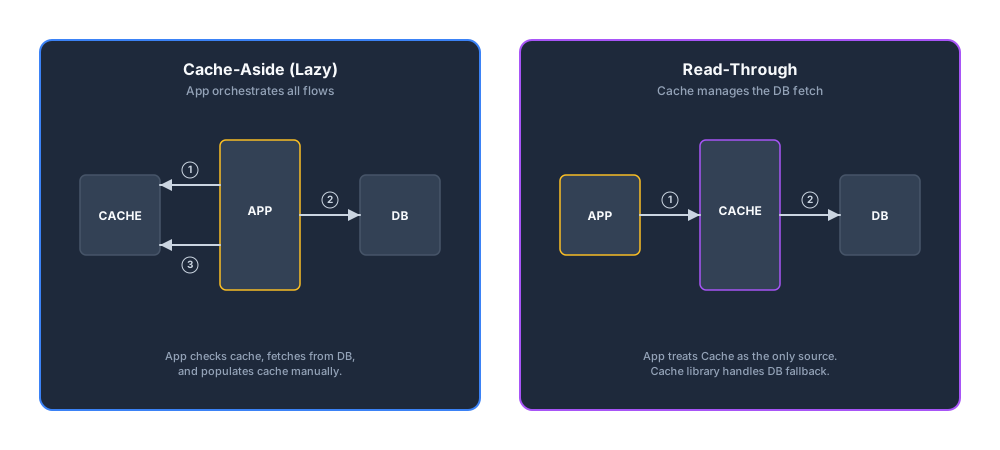
Section titled “Read Strategies”1) Cache-Aside (Lazy Loading)
Section titled “1) Cache-Aside (Lazy Loading)”Flow:
- app reads cache,
- on miss, app reads DB,
- app populates cache.
Pros:
- simple and common,
- good control in application layer.
Cons:
- cache miss penalty hits request path,
- stale data risk unless invalidation is handled well.
2) Read-Through
Section titled “2) Read-Through”Flow:
- app asks cache,
- cache fetches from DB on miss,
- cache returns and stores value.
Pros:
- cleaner app code,
- central cache population logic.
Cons:
- tighter coupling to cache/data adapter,
- less app-level flexibility.
Write Strategies
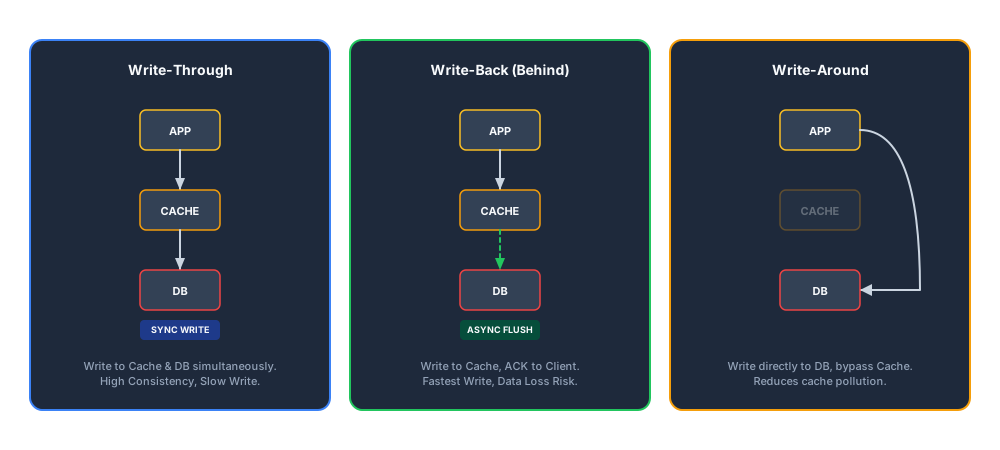
Section titled “Write Strategies”1) Write-Through
Section titled “1) Write-Through”Write to cache and DB in same path (usually sync).
Pros:
- cache + DB stay closely aligned,
- low data-loss risk.
Cons:
- higher write latency,
- DB write cost on every request.
2) Write-Back (Write-Behind)
Section titled “2) Write-Back (Write-Behind)”Write to cache first; DB update happens asynchronously later.
Pros:
- very low write latency,
- absorbs bursty write traffic.
Cons:
- risk of data loss on cache failure before flush,
- more complex durability/replay pipeline.
3) Write-Around
Section titled “3) Write-Around”Write directly to DB, skip cache on write.
Pros:
- avoids polluting cache with cold write data,
- simpler cache invalidation for write-heavy workloads.
Cons:
- next read likely misses cache and hits DB.
- Stale cache reads if the key is still present: the write updates only the DB, so you must invalidate or let the entry expire (TTL); otherwise clients can read an old cached value until then.
Trade-off Summary
Section titled “Trade-off Summary”| Strategy | Read Latency | Write Latency | Consistency | Data Loss Risk |
|---|---|---|---|---|
| Cache-Aside | Fast on hit, miss penalty | N/A | Depends on invalidation | Low |
| Read-Through | Fast on hit, managed miss | N/A | Similar to cache-aside | Low |
| Write-Through | Good read freshness | Higher | Stronger cache/DB alignment | Low |
| Write-Back | Good after warm cache | Lowest | Eventual | Higher if flush fails |
| Write-Around | Miss after writes | Moderate | DB-first correctness | Low |
Common Combinations
Section titled “Common Combinations”E-commerce style
Section titled “E-commerce style”- Cache-aside + write-through for inventory/price/order-adjacent reads.
- Goal: fast reads with stronger write correctness.
Social/media feed style
Section titled “Social/media feed style”- Read-through + write-back for high-throughput timelines/interactions.
- Goal: absorb spikes and trade strict immediacy for throughput.
Operational Rules That Matter
Section titled “Operational Rules That Matter”- Define cache invalidation ownership clearly.
- Set TTLs by data volatility, not one global value.
- Protect DB from thundering herd (request coalescing, jittered TTL).
- Monitor hit ratio, eviction rate, stale-read incidents, flush lag.
- Add fallback behavior for cache outages.
Practical Selection Guide
Section titled “Practical Selection Guide”- Prefer cache-aside as baseline for most services.
- Use write-through for correctness-sensitive writes.
- Use write-back only with strong durability controls.
- Use write-around when write volume is high and re-read probability is low.