Back of the Envelope Calculation
1️⃣ What is Back-of-the-Envelope Calculation?
Section titled “1️⃣ What is Back-of-the-Envelope Calculation?”Back-of-the-envelope (BOE) calculations are quick, rough estimates used to evaluate the feasibility of a system before designing it in detail. These help in estimating storage, bandwidth, memory, and processing needs efficiently.
2️⃣ Understanding Data Size Conversions
Section titled “2️⃣ Understanding Data Size Conversions”Before diving into calculations, let’s define unit conversions to avoid confusion:
Data Size Units
Section titled “Data Size Units”| Unit 📏 | Equivalent Value | |
|---|---|---|
| 1 KB (Kilobyte) | 1,000 bytes = 10³ bytes | |
| 1 MB (Megabyte) | 1,000 KB = 10⁶ bytes | |
| 1 GB (Gigabyte) | 1,000 MB = 10⁹ bytes | |
| 1 TB (Terabyte) | 1,000 GB = 10¹² bytes | |
| 1 PB (Petabyte) | 1,000 TB = 10¹⁵ bytes | |
| 1 EB (Exabyte) | 1,000 PB = 10¹⁸ bytes |
Large Number Notations
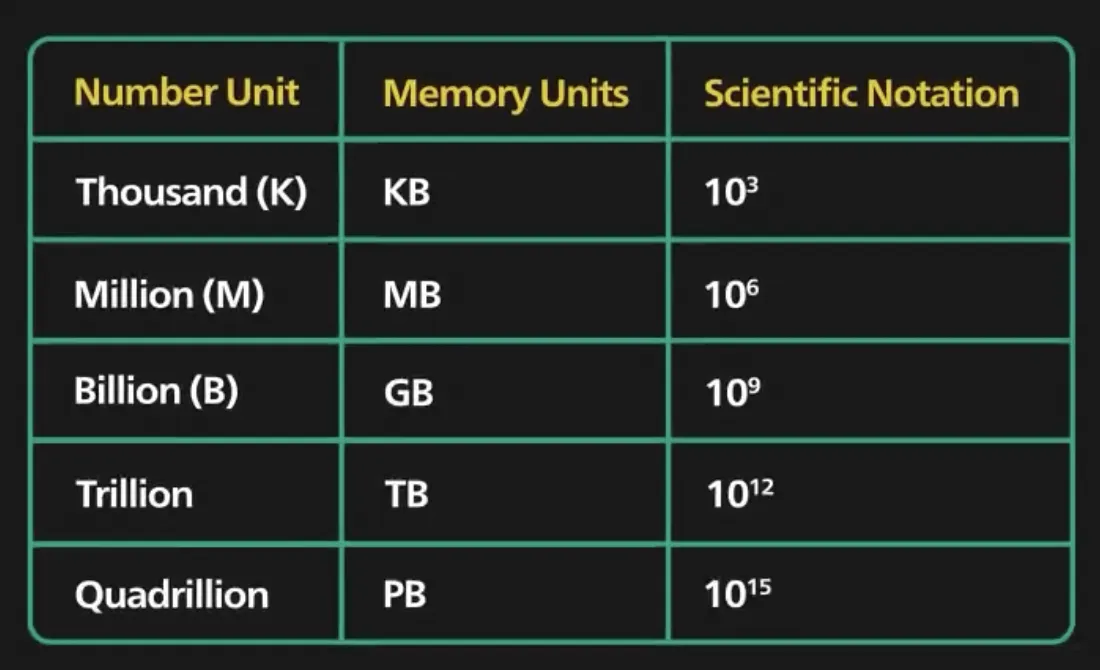
Section titled “Large Number Notations”| Name | Value | Scientific Notation | Zeros |
|---|---|---|---|
| Thousand | 1,000 | 10³ | 1,000 |
| Million | 1,000,000 | 10⁶ | 1,000,000 |
| Billion | 1,000,000,000 | 10⁹ | 1,000,000,000 |
| Trillion | 1,000,000,000,000 | 10¹² | 1,000,000,000,000 |
| Quadrillion | 1,000,000,000,000,000 | 10¹⁵ | 1,000,000,000,000,000 |
| Quintillion | 1,000,000,000,000,000,000 | 10¹⁸ | 1,000,000,000,000,000,000 |
Quick Reference for Calculations
Section titled “Quick Reference for Calculations”- 1 Million = 1M = 10⁶
- 1 Billion = 1B = 10⁹
- 1 Trillion = 1T = 10¹²
📌 Example:
A 5 MB file = 5 × 1,000 × 1,000 bytes = 5,000,000 bytes (5 million bytes).
3️⃣ Traffic Estimation (Requests Per Second - RPS) ⚡
Section titled “3️⃣ Traffic Estimation (Requests Per Second - RPS) ⚡”Estimating the number of requests a system handles helps in designing load balancers, databases, and caching systems.
Formula:
Section titled “Formula:”Total RPS = Total Users * Active Users Ratio * Requests per Active User per SecondExample Calculation:
Section titled “Example Calculation:”🔹 Given:
- A system has 100 million registered users.
- 10% are active daily → 10 million active users.
- Each user makes 10 requests per minute.
🔹 Calculation:
- Requests per second per user = (10/60 = 0.167) requests per second.
- Total RPS:
10,000,000 * 0.167 = 1,670,000 { RPS (1.67 million requests/sec)}
4️⃣ Storage Estimation 🏦
Section titled “4️⃣ Storage Estimation 🏦”Estimating storage helps in planning databases, replication, and backup strategies.
Formula:
Section titled “Formula:”Total Storage per Year = Data per Request * Total Requests per YearExample Calculation:
Section titled “Example Calculation:”🔹 Given:
- Each request generates 2 KB of data.
- System handles 1.67 million RPS.
- Requests per year:
1.67 * 10^6 * 60 * 60 * 24 * 365= 52.6 * 10^{12} { (52.6 trillion requests per year)}
🔹 Storage Required:
52.6 * 10^{12} * 2 { KB} = 105.2 { PB per year}🔹 Considering Replication & Backups:
- If 3x replication, total storage = 315.6 PB per year.
- If backups are kept for one year, total storage needed = 631.2 PB.
📌 Scale Reference:
- 1 PB = 1,000 TB
- 1 PB ≈ Storage of 223 million HD movies (4.5 GB each)
5️⃣ Memory Estimation (Cache & DB Indexing) 🛠️
Section titled “5️⃣ Memory Estimation (Cache & DB Indexing) 🛠️”Determining cache size ensures efficient system performance.
Cache Size Estimation Formula:
Section titled “Cache Size Estimation Formula:”Cache Size = Data per Object * Objects Stored in CacheExample Calculation:**
Section titled “Example Calculation:**”🔹 Given:
- 20% of requests are cached.
- Each cached response = 2 KB.
- System handles 1.67M RPS.
🔹 Calculation:
- Data in cache per second =
1.67 * 10^6 * 0.2 * 2 = 670 { MB per second}
- Data stored in cache for 1 hour:
670 * 3,600 = 2.41 { TB}
- Total RAM required ≈ 2.5 TB.
6️⃣ Quick Cheat Sheet for BOE Calculations 📌
Section titled “6️⃣ Quick Cheat Sheet for BOE Calculations 📌”| Metric 🛠️ | Formula |
|---|---|
| Requests Per Second (RPS) | Users × Active Ratio × Requests per User |
| Storage Per Year | RPS × Data per Request × Seconds in a Year |
| Cache Size | Cache % × RPS × Data per Object × Cache Retention Time |
| Bandwidth | RPS × Data per Response |
| CPU Servers Needed | (RPS × CPU Time per Request) / (Cores per Server × Utilization) |
7️⃣ CPU Server Estimation 🖥️
Section titled “7️⃣ CPU Server Estimation 🖥️”Calculating required servers is crucial for capacity planning and cost estimation.
Formula:
Section titled “Formula:”Number of Servers = (RPS × CPU time per request) / (Cores per server × Core utilization × Seconds)Example Calculation:
Section titled “Example Calculation:”🔹 Given:
- System handles 1.67M RPS
- Each request takes 50ms (0.05s) of CPU time
- Each server has 32 cores
- Target CPU utilization: 80% (0.8)
🔹 Calculation:
Servers = (1,670,000 × 0.05) / (32 × 0.8 × 1) = 83,500 / 25.6 ≈ 3,262 serversServer Capacity Planning Matrix
Section titled “Server Capacity Planning Matrix”| Request Complexity | CPU Time | Max RPS per Core |
|---|---|---|
| Light (cache hit) | 1ms | 1,000 |
| Medium (DB read) | 10ms | 100 |
| Heavy (DB write/compute) | 50ms | 20 |
| Very Heavy (complex computation) | 100ms | 10 |
Example with Buffers:
Base servers needed = 3,262Peak load buffer (2x) = 6,524Growth buffer (50%) = 9,786Redundancy (30%) = 12,722 servers