🎯 Object-Oriented Programming (OOP) in Java
🏗️ What is OOP?
Section titled “🏗️ What is OOP?”Java is a pure object-oriented language (except for primitive types). Most of the power and flexibility in Java comes from its support for OOP principles. This section is critical for interviews, both for concept-based and coding questions.
🌟 What OOP Brings to the Table
Section titled “🌟 What OOP Brings to the Table”| Benefit | Description |
|---|---|
| Modularity | Separation of concerns - each class has a single responsibility |
| Reusability | Components can be reused across projects |
| Extensibility | Easy to extend functionality without modifying existing code |
| Maintainability | Organized and clean codebase |
| Lower Cost & Faster Development | Due to reusable code and better organization |
🔑 Core OOP Principles
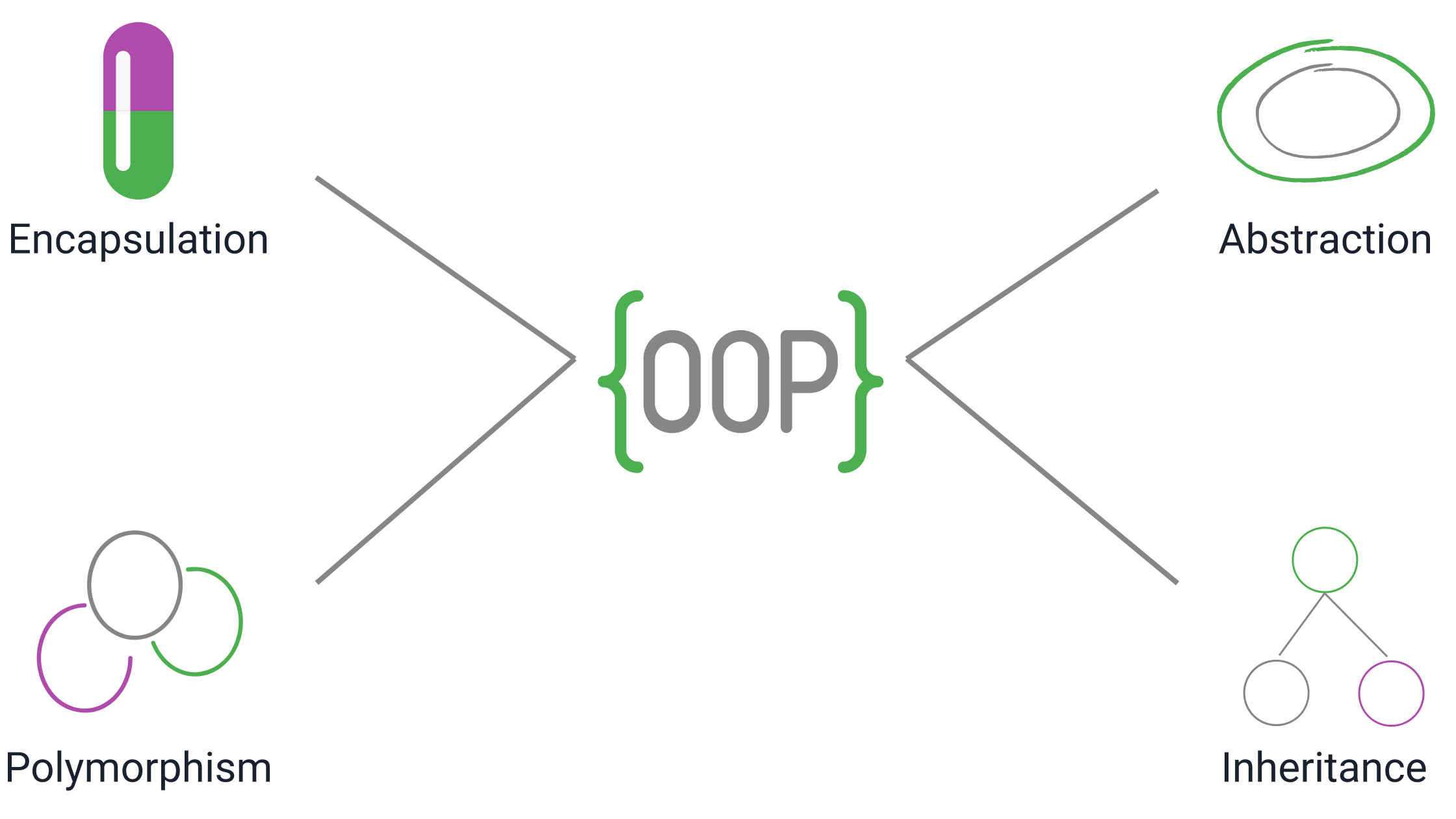
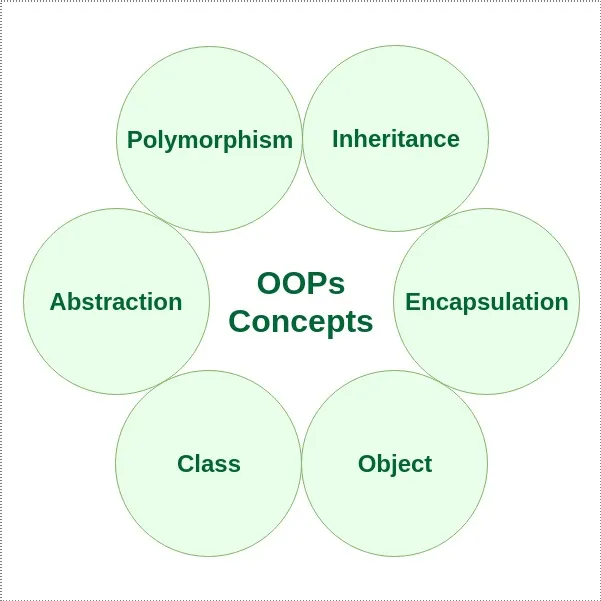
Section titled “🔑 Core OOP Principles”Java follows four main OOP principles:
- Inheritance - Code reuse through “is-a” relationships
- Polymorphism - Same interface, different implementations
- Encapsulation - Data hiding and controlled access
- Abstraction - Hiding complexity, showing only essentials
🧬 Inheritance
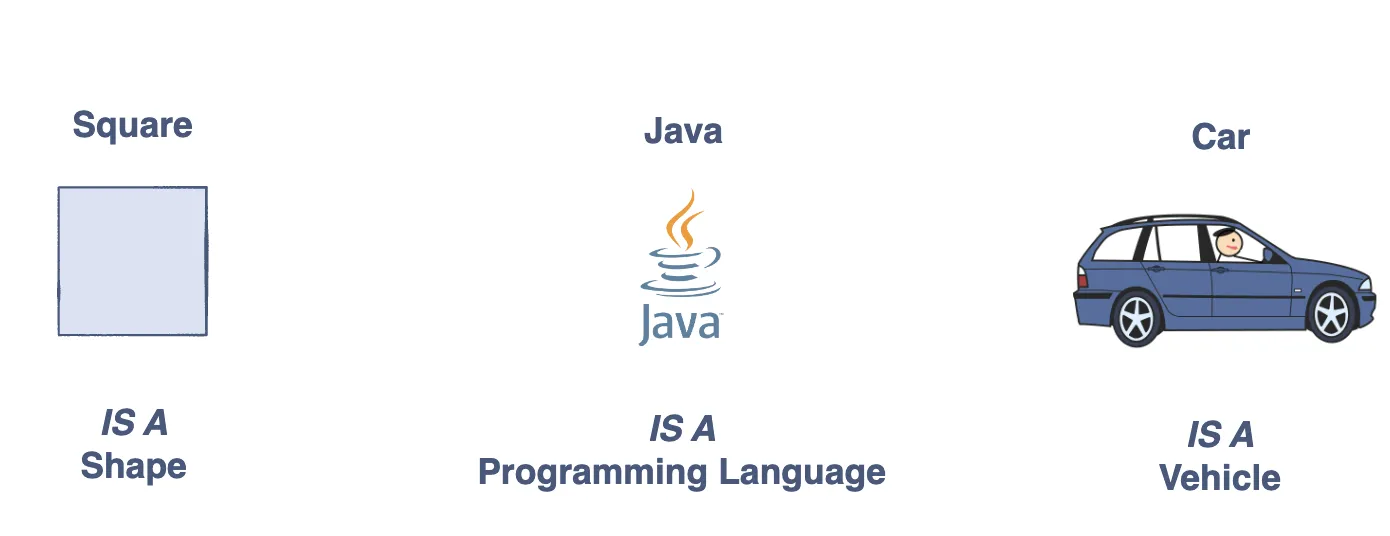
Section titled “🧬 Inheritance”Inheritance allows a class (child/subclass) to derive properties and methods from another class (parent/superclass).
🔑 Key Concepts
Section titled “🔑 Key Concepts”- Keyword:
extends - Purpose: Promotes code reuse and establishes an “is-a” relationship
- Relationship: Child class is-a type of parent class
class DerivedClass extends BaseClass { // methods and fields}📌 Benefits of Inheritance
Section titled “📌 Benefits of Inheritance”- ✅ Code Reuse - Don’t repeat code across similar classes
- ✅ Establishes “is-a” Relationship - Clear hierarchy and relationships
- ✅ Polymorphism - Can use child objects where parent types are expected

🧠 Types of Inheritance
Section titled “🧠 Types of Inheritance”1. Single Inheritance
Section titled “1. Single Inheritance”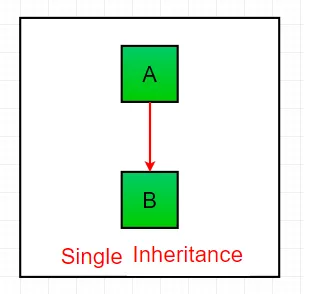
class Animal { }class Dog extends Animal { } // Dog inherits from Animal2. Multilevel Inheritance
Section titled “2. Multilevel Inheritance”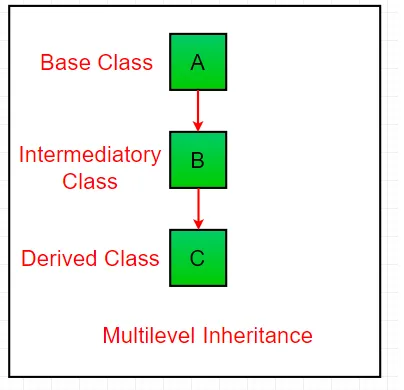
class Animal { }class Mammal extends Animal { }class Dog extends Mammal { } // Dog inherits from Mammal, which inherits from Animal3. Hierarchical Inheritance
Section titled “3. Hierarchical Inheritance”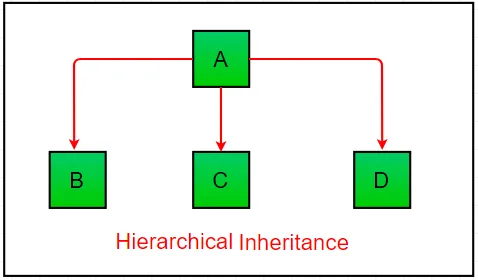
class Animal { }class Dog extends Animal { }class Cat extends Animal { } // Both Dog and Cat inherit from Animal4. Multiple Inheritance (via Interfaces Only)
Section titled “4. Multiple Inheritance (via Interfaces Only)”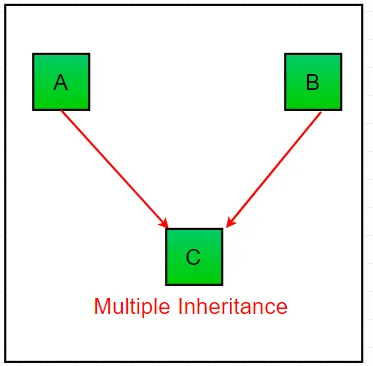
interface Flyable { }interface Swimmable { }class Duck implements Flyable, Swimmable { } // Duck can fly and swim📌 Important Inheritance Rules
Section titled “📌 Important Inheritance Rules”What Gets Inherited:
Section titled “What Gets Inherited:”- ✅ Public and protected members (fields and methods)
- ✅ Default (package-private) members within the same package
- ❌ Private members - but can be accessed via getters/setters
- ❌ Constructors - but
super()can be used to call parent constructor
What Subclasses Can Do:
Section titled “What Subclasses Can Do:”- Inherit as-is - Use parent’s implementation
- Override methods - Provide new implementation
- Hide static methods - Define new static method with same signature
- Add new members - Extend functionality
🔁 Constructor Rules in Inheritance
Section titled “🔁 Constructor Rules in Inheritance”| Rule | Explanation |
|---|---|
| Cannot Override | Constructors are tied to the class, not inherited |
| Can Overload | Multiple constructors with different parameters |
super() and this() | Only one allowed, must be first line |
| Default Constructor | Injected only if no custom constructors exist |
❌ Critical Rule: Never Use super() and this() Together
Section titled “❌ Critical Rule: Never Use super() and this() Together”public class MyClass { MyClass() { this(5); // ❌ this() must be first super(); // ❌ super() also must be first — this is illegal! }
MyClass(int x) { // constructor logic }}Correct Usage:
public class MyClass {    MyClass() {        this(5);      // ✅ this() is first    }
    MyClass(int x) {        super();      // ✅ super() is first        // constructor logic    }}
🥋 Polymorphism
Section titled “🥋 Polymorphism”Polymorphism is the ability of an object to take on many forms. It allows you to perform a single action in different ways, depending on the object that is performing the action.
🧷 Types of Polymorphism
Section titled “🧷 Types of Polymorphism”1. Compile-Time Polymorphism (Static)
Section titled “1. Compile-Time Polymorphism (Static)”- Method Overloading - Same method name, different parameters
- Operator Overloading - Limited in Java (mainly
+operator)
2. Runtime Polymorphism (Dynamic)
Section titled “2. Runtime Polymorphism (Dynamic)”- Method Overriding - Subclass provides specific implementation
- Uses upcasting and dynamic dispatch
🌟 Covariant Return Types
Section titled “🌟 Covariant Return Types”class Animal { Animal get() { return new Animal(); }}
class Dog extends Animal { Dog get() { return new Dog(); } // ✅ More specific return type}🤯 Common Tricky Questions
Section titled “🤯 Common Tricky Questions”Q: Can you have multiple main() methods?
Section titled “Q: Can you have multiple main() methods?”public class MultipleMain { public static void main(String[] args) { System.out.println("Main with String[] args"); }
public static void main(String arg) { System.out.println("Main with String arg"); }
public static void main() { System.out.println("Main with no args"); }}Q: Can you override only the return type?
Section titled “Q: Can you override only the return type?”class Parent { Number getValue() { return 0; }}
class Child extends Parent { Integer getValue() { return 1; } // ✅ Integer extends Number}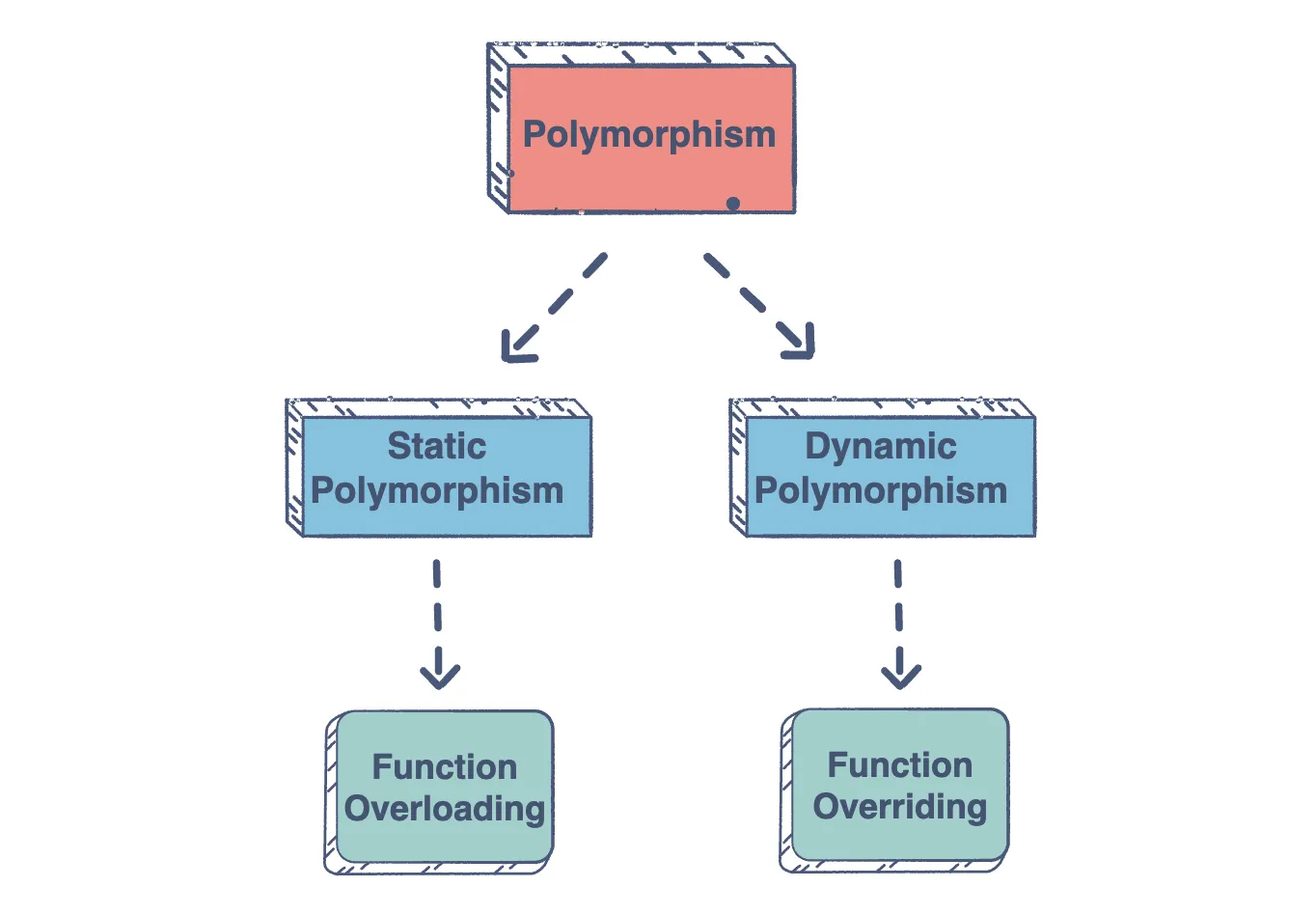
📚 Method Overloading
Section titled “📚 Method Overloading”Overloading Rules:
Section titled “Overloading Rules:”- Change in number of arguments
- Change in type of arguments
- Return type alone is NOT sufficient for overloading
public class Calculator {    // Overloaded sum with different number of parameters    public int sum(int x, int y) {        return (x + y);    }
    public int sum(int x, int y, int z) {        return (x + y + z);    }
    // Overloaded sum with different argument types    public double sum(double x, double y) {        return (x + y);    }
    public static void main(String args[]) {        Calculator calc = new Calculator();        System.out.println(calc.sum(10, 20));      // Output: 30        System.out.println(calc.sum(10, 20, 30)); // Output: 60        System.out.println(calc.sum(10.5, 20.5)); // Output: 31.0    }}
🔧 Operator Overloading
Section titled “🔧 Operator Overloading”class OperatorDemo { void operator(String str1, String str2) { String s = str1 + str2; System.out.println("Concatenated String - " + s); }
void operator(int a, int b) { int c = a + b; System.out.println("Sum = " + c); }}
class Main { public static void main(String[] args) { OperatorDemo obj = new OperatorDemo(); obj.operator(2, 3); // Output: Sum = 5 obj.operator("Hello", "World"); // Output: Concatenated String - HelloWorld }}🔄 Method Overriding
Section titled “🔄 Method Overriding”Override Rules:
Section titled “Override Rules:”- Same method signature (name, return type, parameters)
- Same or covariant return type
- Same or broader access modifier
- Same or narrower exception specification
class Parent {    void show() {        System.out.println("Parent's show()");    }}
class Child extends Parent {    // This method overrides show() of Parent    @Override    void show() {        System.out.println("Child's show()");    }}
class Main {    public static void main(String[] args) {        Parent obj;
        // Parent reference, Parent object        obj = new Parent();        obj.show();  // Output: Parent's show()
// Parent reference, Child object - RUNTIME POLYMORPHISM! obj = new Child(); obj.show(); // Output: Child's show() }}What Cannot Be Overridden:
Section titled “What Cannot Be Overridden:”Exception Handling in Overriding:
Section titled “Exception Handling in Overriding:”Rule #1: No Exception in Superclass
Section titled “Rule #1: No Exception in Superclass”class Parent { void m1() { System.out.println("From parent m1()"); }}
class Child extends Parent { @Override // ✅ No issue while throwing unchecked exception void m1() throws ArithmeticException { System.out.println("From child m1()"); }
@Override // ❌ Compile-time error while throwing checked exception void m2() throws Exception { System.out.println("From child m2"); }}Rule #2: Exception in Superclass
Section titled “Rule #2: Exception in Superclass”class Parent { void m1() throws RuntimeException { System.out.println("From parent m1()"); }}
class Child1 extends Parent { @Override // ✅ No issue while throwing same exception void m1() throws RuntimeException { System.out.println("From child1 m1()"); }}
class Child2 extends Parent { @Override // ✅ No issue while throwing subclass exception void m1() throws ArithmeticException { System.out.println("From child2 m1()"); }}
class Child3 extends Parent { @Override // ✅ No issue while not throwing any exception void m1() { System.out.println("From child3 m1()"); }}
class Child4 extends Parent { @Override // ❌ Compile-time error while throwing parent exception void m1() throws Exception { System.out.println("From child4 m1()"); }}Static Methods Cannot Be Overridden
Section titled “Static Methods Cannot Be Overridden”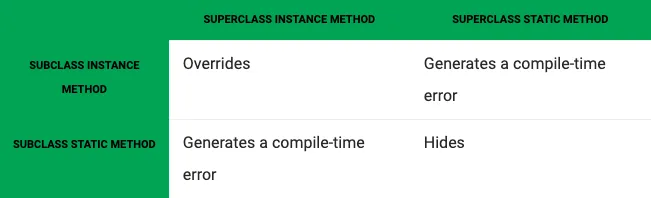
💊 Encapsulation (Data Hiding)
Section titled “💊 Encapsulation (Data Hiding)”Encapsulation = data hiding + controlled access using getters/setters.
🎯 How to Achieve Encapsulation
Section titled “🎯 How to Achieve Encapsulation”- Make variables
private- Hide data from outside world - Provide
publicgetters and setters - Control access to data
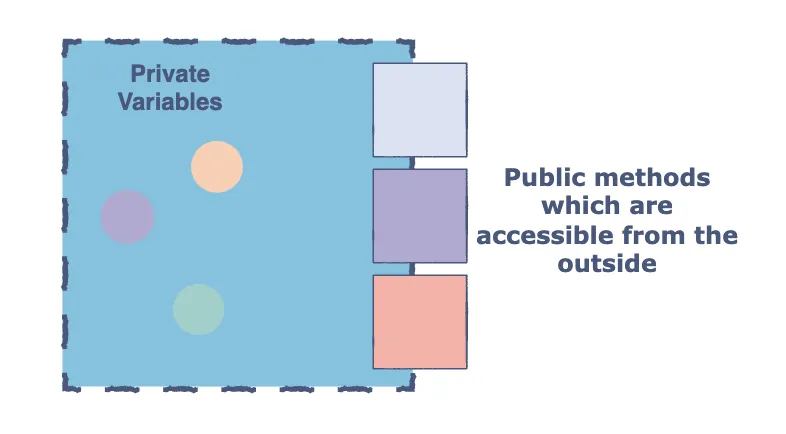
💻 Implementation Example
Section titled “💻 Implementation Example”public class Person { // Private fields - data is hidden private String name; private int age; private String email;
// Constructor public Person(String name, int age, String email) { this.name = name; this.age = age; this.email = email; }
// Getter for name public String getName() { return name; }
// Setter for name with validation public void setName(String newName) { if (newName != null && !newName.trim().isEmpty()) { this.name = newName.trim(); } }
// Getter for age public int getAge() { return age; }
// Setter for age with validation public void setAge(int newAge) { if (newAge >= 0 && newAge <= 150) { this.age = newAge; } }
// Getter for email public String getEmail() { return email; }
// Setter for email with validation public void setEmail(String newEmail) { if (newEmail != null && newEmail.contains("@")) { this.email = newEmail; } }}
// Using the encapsulated classclass Main { public static void main(String[] args) { Person person = new Person("Alice", 30, "alice@email.com");
// Access data through controlled methods System.out.println("Name: " + person.getName()); System.out.println("Age: " + person.getAge());
// Modify data through controlled methods person.setAge(31); person.setEmail("alice.new@email.com");
System.out.println("Updated Age: " + person.getAge()); System.out.println("Updated Email: " + person.getEmail()); }}✅ Benefits of Encapsulation
Section titled “✅ Benefits of Encapsulation”- Data Protection - External code cannot directly modify private data
- Flexibility & Modularity - Can change internal implementation without affecting external code
- Data Validation - Can add validation logic in setters
- Maintainability - Easier to maintain and modify code
🧼 Abstraction (Detail Hiding)
Section titled “🧼 Abstraction (Detail Hiding)”Abstraction = hiding implementation and exposing essential features.
🧠 Simple Analogy
Section titled “🧠 Simple Analogy”Think of a car: You view it as a car with essential features (start, stop, accelerate, brake) rather than its individual components (engine, transmission, brakes).
🎯 What Abstraction Contains
Section titled “🎯 What Abstraction Contains”- Abstract methods - Methods without implementation
- Concrete methods - Methods with implementation
- Cannot be instantiated directly
💻 Abstract Class Example
Section titled “💻 Abstract Class Example”abstract class Shape { protected String color;
// Constructor public Shape(String color) { this.color = color; }
// Abstract method - must be implemented by subclasses public abstract double calculateArea();
// Concrete method - has implementation public String getColor() { return color; }
public void setColor(String color) { this.color = color; }}
class Circle extends Shape { private double radius;
public Circle(String color, double radius) { super(color); this.radius = radius; }
@Override public double calculateArea() { return Math.PI * radius * radius; }}
class Rectangle extends Shape { private double length; private double width;
public Rectangle(String color, double length, double width) { super(color); this.length = length; this.width = width; }
@Override public double calculateArea() { return length * width; }}🔄 Encapsulation vs Abstraction
Section titled “🔄 Encapsulation vs Abstraction”| Feature | Encapsulation | Abstraction |
|---|---|---|
| Purpose | Data hiding | Implementation hiding |
| Access | Via getters/setters | Via abstract classes/interfaces |
| Focus | How data is accessed | What functionalities are exposed |
| Level | Low-level (data) | High-level (design) |
📘 Interfaces
Section titled “📘 Interfaces”🔑 Key Characteristics
Section titled “🔑 Key Characteristics”- All methods are implicitly
publicandabstract - All fields are
public static final - Used for multiple inheritance and 100% abstraction
- A class can implement multiple interfaces
- An interface can extend multiple interfaces
🌟 Why Use Interfaces When We Have Abstract Classes?
Section titled “🌟 Why Use Interfaces When We Have Abstract Classes?”| Aspect | Abstract Class | Interface |
|---|---|---|
| Variables | Can contain non-final variables | Variables are implicitly final, public, and static |
| Inheritance | A class can extend only one abstract class | A class can implement multiple interfaces |
| Constructor | Can have constructors | Cannot have constructors |
| Method Implementation | Can have concrete methods | All methods are abstract (before Java 8) |
💻 Interface Example
Section titled “💻 Interface Example”interface Flyable { // public, static and final final int MAX_ALTITUDE = 10000;
// public and abstract void fly(); void land();}
interface Swimmable { void swim(); void dive();}
// A class that implements multiple interfacesclass Duck implements Flyable, Swimmable { @Override public void fly() { System.out.println("Duck is flying"); }
@Override public void land() { System.out.println("Duck is landing"); }
@Override public void swim() { System.out.println("Duck is swimming"); }
@Override public void dive() { System.out.println("Duck is diving"); }
public static void main(String[] args) { Duck duck = new Duck(); duck.fly(); duck.swim(); System.out.println("Max altitude: " + MAX_ALTITUDE); }}Output:
Duck is flyingDuck is swimmingMax altitude: 10000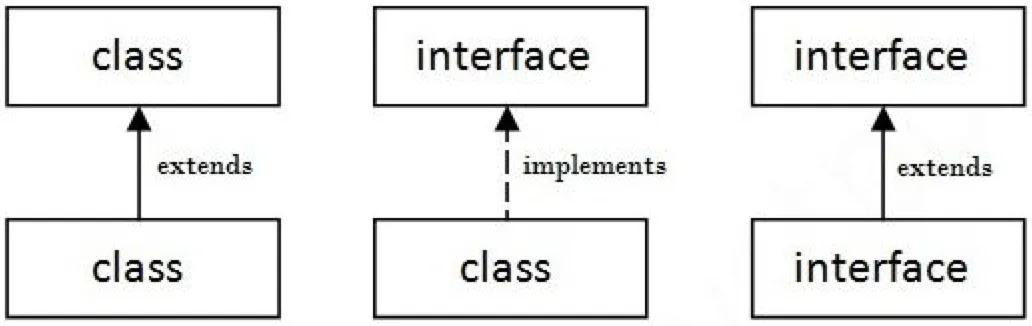
🧩 Quick Reference Flashcards
Section titled “🧩 Quick Reference Flashcards”| Concept | Summary |
|---|---|
| Inheritance | Code reuse via “is-a” relationship using extends |
| Overloading | Same method name, different parameters (compile-time) |
| Overriding | Subclass redefines superclass method (runtime) |
| Encapsulation | Private data + public accessors for controlled access |
| Abstraction | Hide implementation, show only functionality |
| Interface | 100% abstraction, enables multiple inheritance |