
Queue Interface
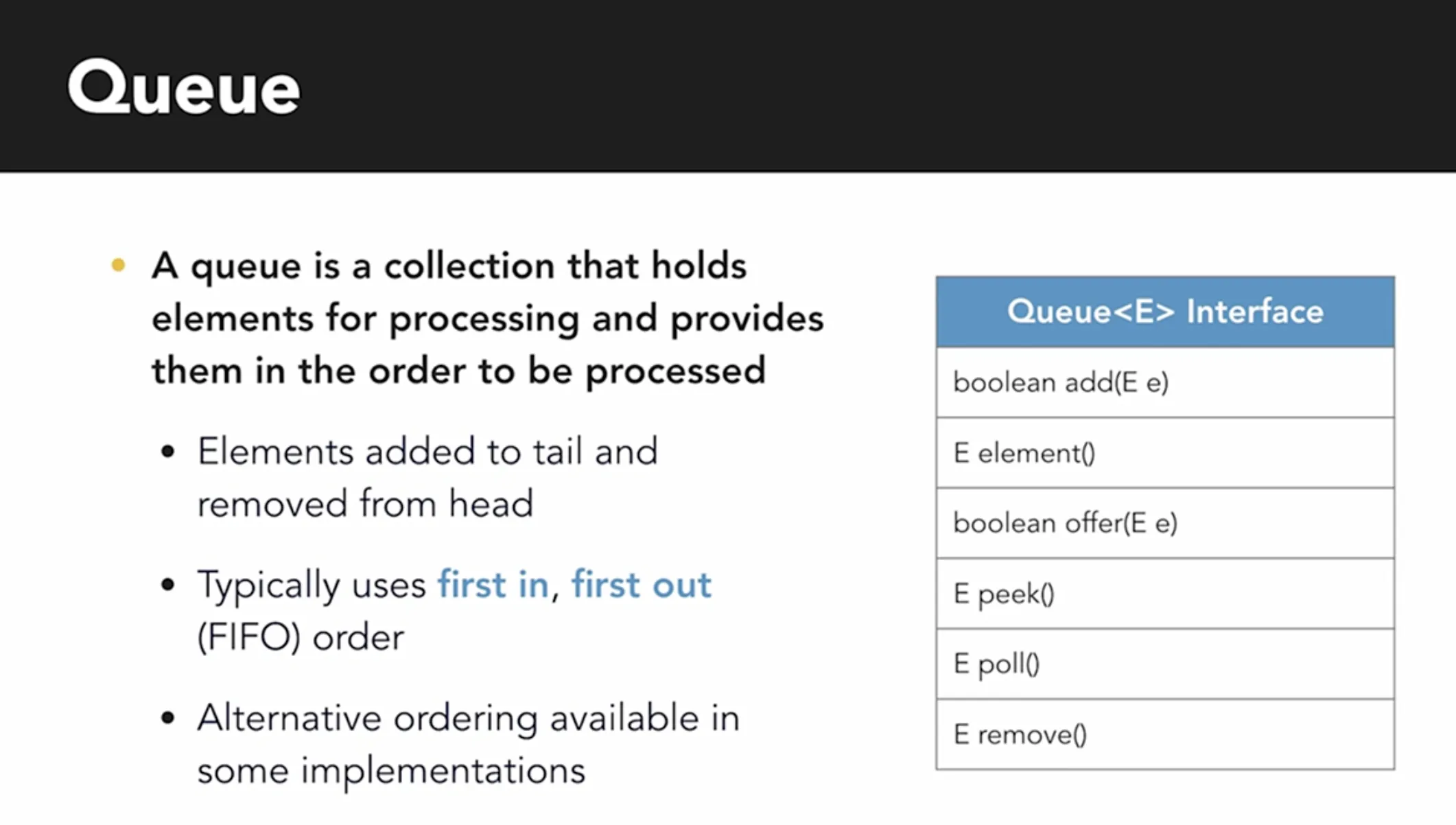
The Queue interface models a collection where elements are inserted at one end and removed from the other — typically FIFO (First-In-First-Out). The Deque (double-ended queue) interface extends it to support insertion and removal at both ends.
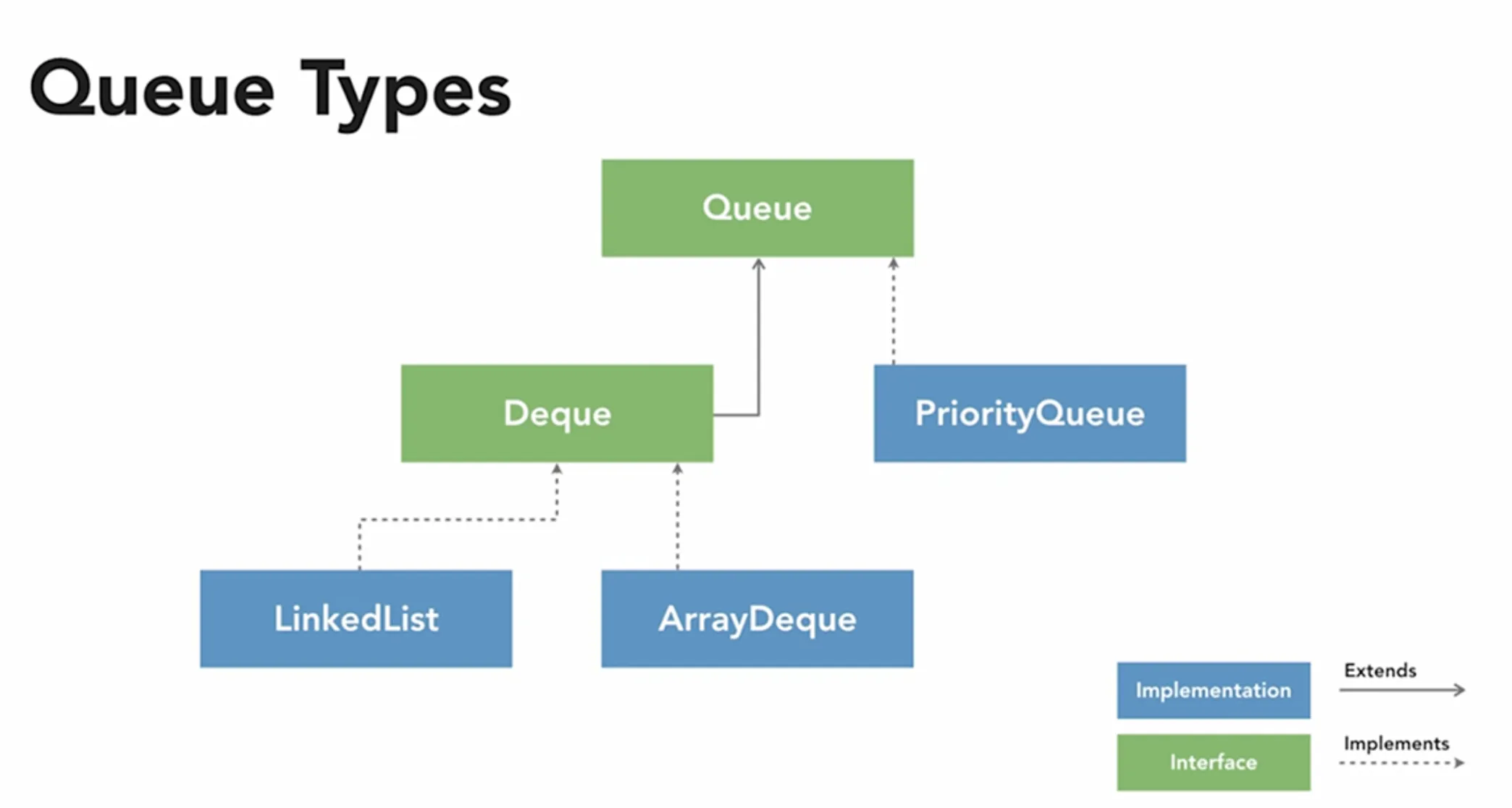
Queue Hierarchy
Section titled “Queue Hierarchy”Queue<E>├── PriorityQueue<E> — heap-based, ordered by priority├── Deque<E> (interface) — double-ended queue│ ├── ArrayDeque<E> — resizable array (recommended for most uses)│ └── LinkedList<E> — also implements List└── BlockingQueue<E> — thread-safe, producer-consumer pattern ├── ArrayBlockingQueue — bounded ├── LinkedBlockingQueue — optionally bounded ├── PriorityBlockingQueue — unbounded, priority-ordered └── SynchronousQueue — zero-capacity handoffTwo Sets of Methods
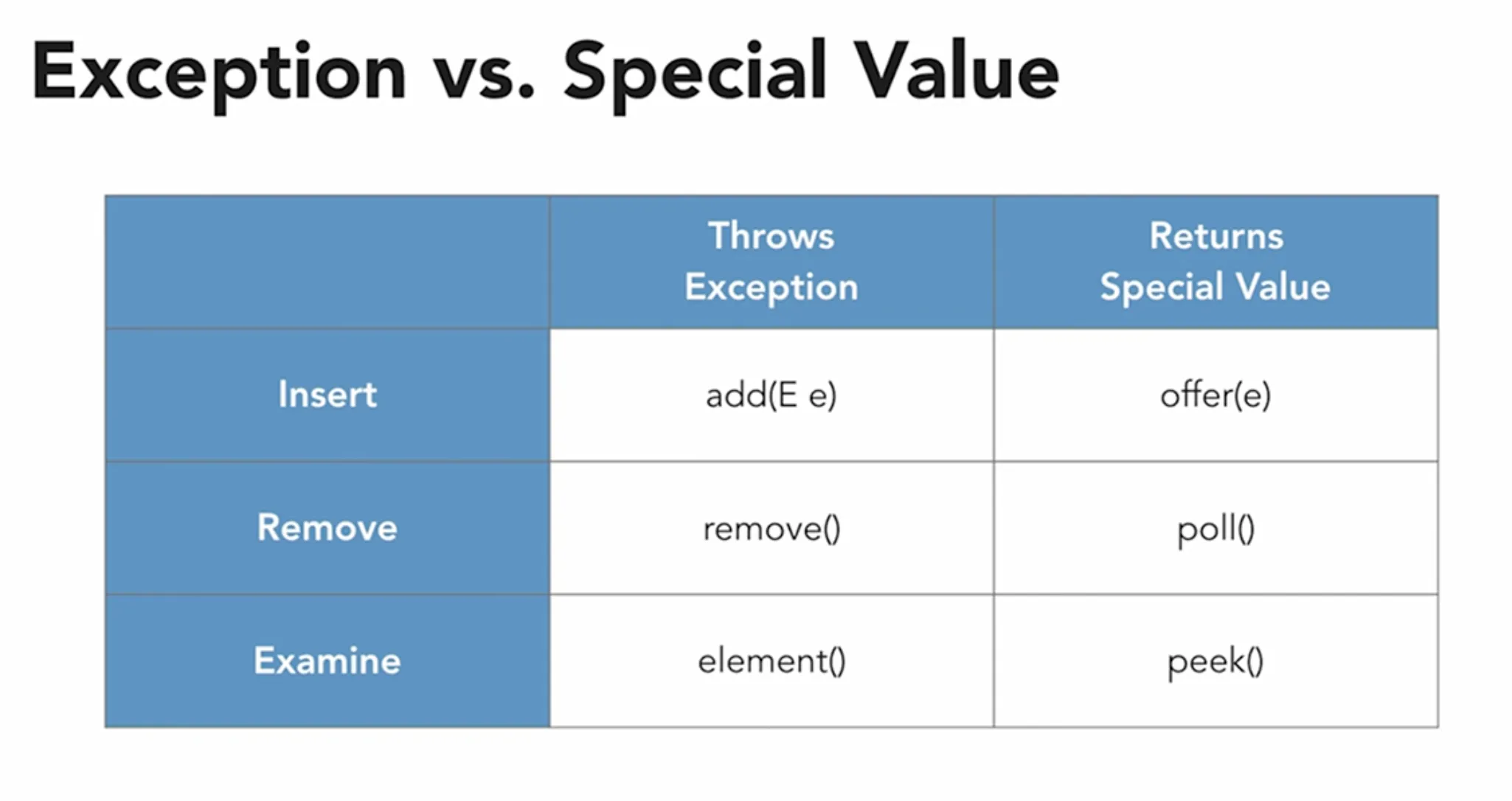
Section titled “Two Sets of Methods”Queue provides two methods for each operation — one throws, one returns a special value:
| Operation | Throws on failure | Returns null/false |
|---|---|---|
| Insert | add(e) | offer(e) |
| Remove | remove() | poll() |
| Examine | element() | peek() |
Prefer offer/poll/peek — they fail gracefully.
Basic Queue Usage
Section titled “Basic Queue Usage”Queue<String> queue = new ArrayDeque<>();
queue.offer("first");queue.offer("second");queue.offer("third");
queue.peek(); // "first" — looks at head without removingqueue.poll(); // "first" — removes and returns headqueue.poll(); // "second"queue.size(); // 1
// Drain the queuewhile (!queue.isEmpty()) { System.out.println(queue.poll());}ArrayDeque — The Default Choice
Section titled “ArrayDeque — The Default Choice”Resizable circular array. Faster than LinkedList for both queue and stack use cases due to better cache locality.
Deque<String> deque = new ArrayDeque<>();
// Queue (FIFO)deque.offerLast("a");    // add to taildeque.pollFirst();       // remove from head
// Stack (LIFO)deque.push("a");         // add to headdeque.pop();             // remove from head
// Both endsdeque.addFirst("start");deque.addLast("end");deque.peekFirst();deque.peekLast();
Default initial capacity is 16. Pre-size with new ArrayDeque<>(expectedSize) if you know the count.
PriorityQueue
Section titled “PriorityQueue”A min-heap that always gives you the smallest element first (by natural ordering or a Comparator). Not FIFO.
// Natural ordering (min first)PriorityQueue<Integer> pq = new PriorityQueue<>();pq.offer(5);pq.offer(2);pq.offer(8);pq.poll();    // 2pq.poll();    // 5pq.poll();    // 8
// Max-heap (largest first)PriorityQueue<Integer> maxPQ = new PriorityQueue<>(Comparator.reverseOrder());
// Custom orderingPriorityQueue<String> byLength = new PriorityQueue<>(    Comparator.comparingInt(String::length));
Key points:
offer/pollare O(log n),peekis O(1)- Iterator does NOT return elements in priority order — only
polldoes - Not thread-safe — use
PriorityBlockingQueuefor concurrency
Implementation Comparison
Section titled “Implementation Comparison”| ArrayDeque | LinkedList | PriorityQueue | BlockingQueue | |
|---|---|---|---|---|
| Ordering | FIFO | FIFO | Priority | FIFO/Priority |
| offer/poll | O(1)* | O(1) | O(log n) | O(1) or O(log n) |
| Memory | Low | High | Low | Medium |
| Thread-safe | No | No | No | Yes |
| Use case | Default queue/stack | Need List + Queue | Scheduling, top-K | Producer-consumer |
*Amortized
When to Use Which
Section titled “When to Use Which”- General-purpose queue or stack →
ArrayDeque - Need both List and Queue methods →
LinkedList - Process by priority, not insertion order →
PriorityQueue - Multi-threaded producer-consumer →
ArrayBlockingQueueorLinkedBlockingQueue