
Stack Operations
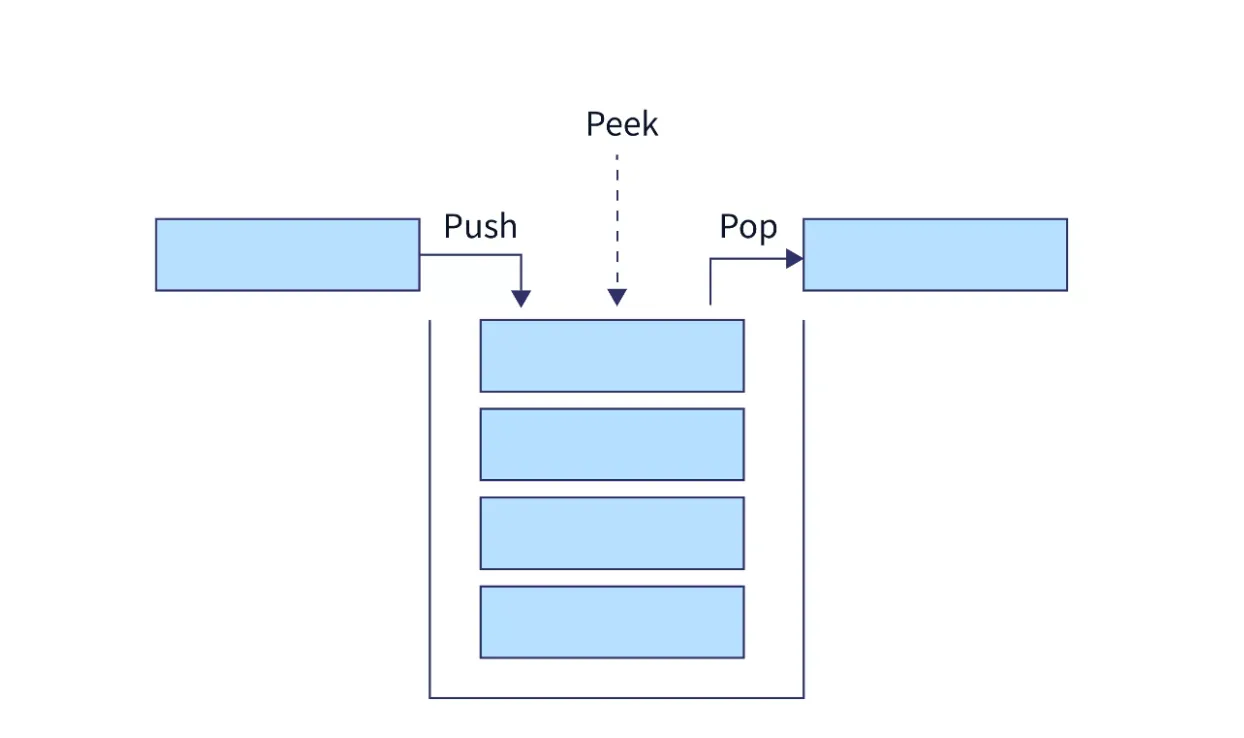
A stack is a LIFO (Last-In-First-Out) data structure. You add and remove elements from the same end — the “top”. Think of a stack of plates.
Which Implementation to Use
Section titled “Which Implementation to Use”| ArrayDeque | LinkedList | Legacy Stack | |
|---|---|---|---|
| push/pop/peek | O(1)* | O(1) | O(1)* |
| Memory | Low | High | Medium |
| Thread-safe | No | No | Yes (but slow) |
| Recommendation | Use this | Acceptable | Avoid |
*Amortized
Use ArrayDeque as your stack. The legacy Stack class extends Vector, carries synchronization overhead you don’t need, and exposes methods (like add(index, element)) that break stack semantics.
Stack with ArrayDeque (Recommended)
Section titled “Stack with ArrayDeque (Recommended)”Deque<String> stack = new ArrayDeque<>();
stack.push("bottom"); // [bottom]stack.push("middle"); // [middle, bottom]stack.push("top"); // [top, middle, bottom]
stack.peek(); // "top" — look without removingstack.pop(); // "top" — removes and returnsstack.pop(); // "middle"stack.isEmpty(); // falsestack.size(); // 1Drain a stack:
while (!stack.isEmpty()) { System.out.println(stack.pop());}Why Not the Legacy Stack Class
Section titled “Why Not the Legacy Stack Class”// Legacy — avoid in new codeStack<String> stack = new Stack<>();stack.push("a");stack.push("b");
// Problem: inherits Vector methods that break LIFO semanticsstack.add(0, "inserted at bottom"); // this shouldn't be possible on a stackstack.remove(1); // random removal from middleThe legacy Stack is synchronized, which adds overhead even in single-threaded code. For thread-safe stacks, use ConcurrentLinkedDeque or synchronize an ArrayDeque explicitly.
Common Stack Patterns
Section titled “Common Stack Patterns”Balanced parentheses:
public boolean isBalanced(String s) { Deque<Character> stack = new ArrayDeque<>(); for (char c : s.toCharArray()) { if (c == '(' || c == '{' || c == '[') { stack.push(c); } else { if (stack.isEmpty()) return false; char open = stack.pop(); if ((c == ')' && open != '(') || (c == '}' && open != '{') || (c == ']' && open != '[')) return false; } } return stack.isEmpty();}Reverse a collection:
Deque<Integer> stack = new ArrayDeque<>();for (int num : list) stack.push(num);
List<Integer> reversed = new ArrayList<>();while (!stack.isEmpty()) reversed.add(stack.pop());
Key Takeaway
Section titled “Key Takeaway”Always declare your stack as Deque<T> and instantiate with ArrayDeque. This gives you the right interface (only stack operations visible) with the best performance.
Deque<String> stack = new ArrayDeque<>(); // correctStack<String> stack = new Stack<>(); // avoid