
Set Interface
The Set interface represents a collection with no duplicate elements. It models the mathematical concept of a set and is primarily used for membership testing and duplicate elimination.
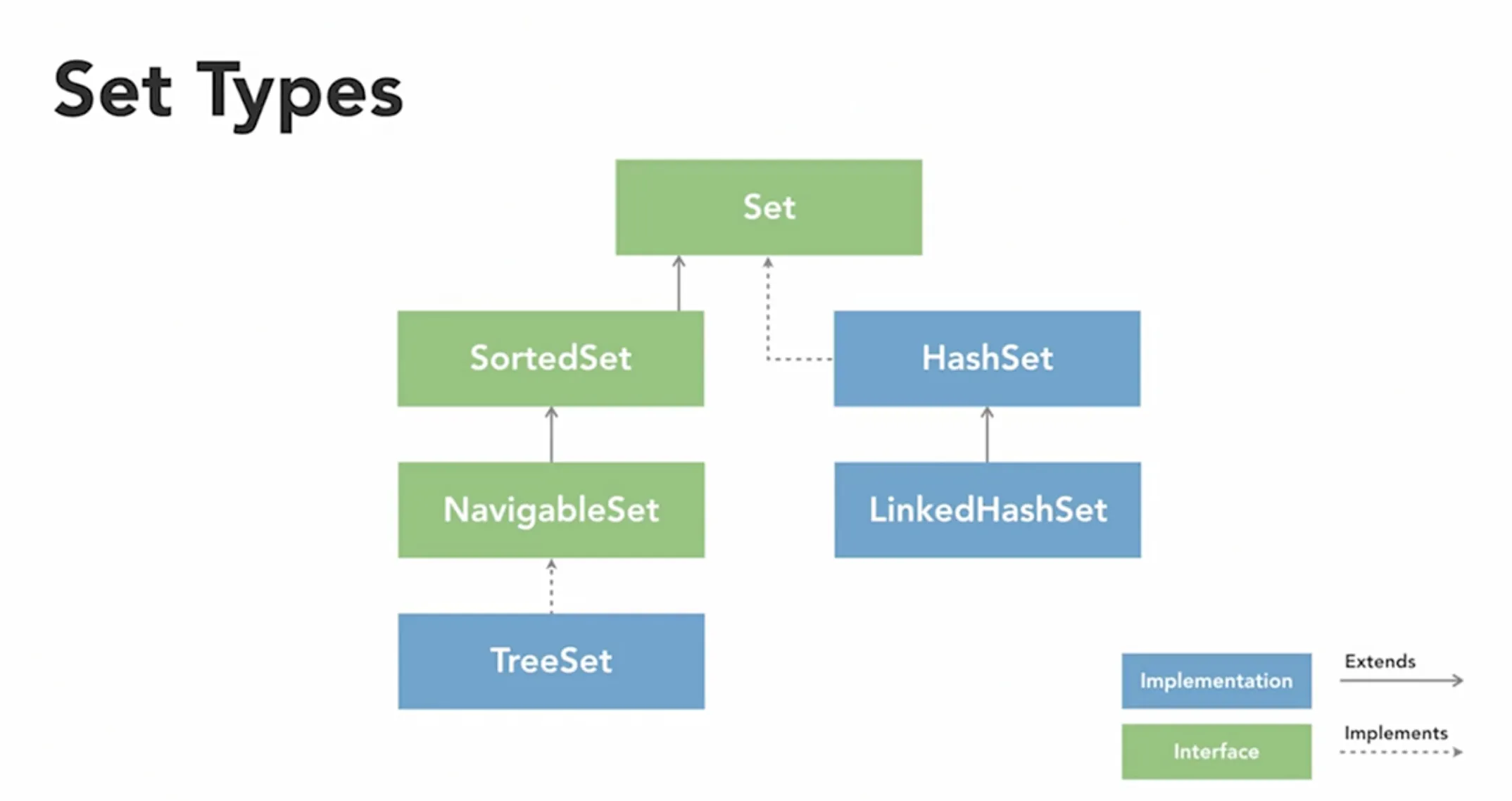
Set Hierarchy
Section titled “Set Hierarchy”Set<E>├── HashSet<E> — hash table, O(1) ops, no ordering├── LinkedHashSet<E> — insertion order preserved├── SortedSet<E> → NavigableSet<E>│ └── TreeSet<E> — red-black tree, sorted order├── EnumSet<E> — bit-vector for enum types (fastest)└── CopyOnWriteArraySet — thread-safe, optimized for readsImplementation Comparison
Section titled “Implementation Comparison”| HashSet | LinkedHashSet | TreeSet | EnumSet | |
|---|---|---|---|---|
| add/remove/contains | O(1)* | O(1)* | O(log n) | O(1) |
| Ordering | None | Insertion | Sorted | Declaration |
| Null | 1 allowed | 1 allowed | No | No |
| Memory | Medium | High | Medium | Very low |
| Thread-safe | No | No | No | No |
*Average case — O(n) worst case due to hash collisions
Basic Usage
Section titled “Basic Usage”Set<String> set = new HashSet<>();
set.add("Alice"); // trueset.add("Bob"); // trueset.add("Alice"); // false — already exists
set.contains("Alice"); // trueset.remove("Bob"); // trueset.size(); // 1Mathematical Set Operations
Section titled “Mathematical Set Operations”Set<String> a = new HashSet<>(List.of("a", "b", "c", "d"));Set<String> b = new HashSet<>(List.of("c", "d", "e", "f"));
// Union (A ∪ B)Set<String> union = new HashSet<>(a);union.addAll(b); // {a, b, c, d, e, f}
// Intersection (A ∩ B)Set<String> inter = new HashSet<>(a);inter.retainAll(b); // {c, d}
// Difference (A − B)Set<String> diff = new HashSet<>(a);diff.removeAll(b); // {a, b}
// Subset checka.containsAll(inter); // trueHashSet
Section titled “HashSet”The default choice for most use cases. Backed by a HashMap internally.
Set<String> set = new HashSet<>();            // capacity 16, load factor 0.75Set<String> set = new HashSet<>(100);         // pre-sizeSet<String> set = new HashSet<>(List.of("a", "b", "c"));
// Remove duplicates from a list in one lineList<String> unique = new ArrayList<>(new HashSet<>(listWithDuplicates));
Important: Objects in a HashSet must properly implement hashCode() and equals(). If two objects are equal, they must have the same hash code.
LinkedHashSet
Section titled “LinkedHashSet”Same performance as HashSet, but preserves insertion order during iteration.
Set<String> set = new LinkedHashSet<>();set.add("banana");set.add("apple");set.add("cherry");// Iteration: banana, apple, cherry (insertion order)Use when you need uniqueness + predictable iteration order.
TreeSet
Section titled “TreeSet”Keeps elements sorted (natural order or via Comparator). Backed by a red-black tree.
TreeSet<Integer> sorted = new TreeSet<>();sorted.addAll(List.of(5, 2, 8, 1, 9));// Iteration: 1, 2, 5, 8, 9
// Navigable methodssorted.ceiling(6);     // 8   — smallest >= 6sorted.floor(6);       // 5   — largest <= 6sorted.higher(5);      // 8   — smallest > 5sorted.lower(5);       // 2   — largest < 5
// Range viewssorted.subSet(2, true, 8, true);  // [2, 5, 8]sorted.headSet(5);                 // [1, 2]sorted.tailSet(5);                 // [5, 8, 9]
// Custom orderingTreeSet<String> desc = new TreeSet<>(Comparator.reverseOrder());
Note: Elements must be Comparable or you must provide a Comparator. Null is not allowed.
Immutable Sets
Section titled “Immutable Sets”// Java 9+ — truly immutableSet<String> immutable = Set.of("a", "b", "c");
// Unmodifiable wrapper (changes in original reflect here)Set<String> unmod = Collections.unmodifiableSet(mutableSet);When to Use Which
Section titled “When to Use Which”| Scenario | Use |
|---|---|
| General-purpose unique collection | HashSet |
| Need insertion order | LinkedHashSet |
| Need sorted order or range queries | TreeSet |
| Enum values only | EnumSet |
| Thread-safe reads | CopyOnWriteArraySet |