equals() vs ==
Understanding object comparison and equality in Java
🎯 Why This Matters
Section titled “🎯 Why This Matters”Understanding the difference between == and equals() is fundamental for Java programming. It affects:
- Object comparison logic
- Collection behavior (HashSet, HashMap)
- Performance of equality checks
- Bug prevention in object comparisons
- Interview success - this is a very common question
💡 Interview Focus: This topic tests your understanding of object identity vs equality, and contract compliance between equals() and hashCode().
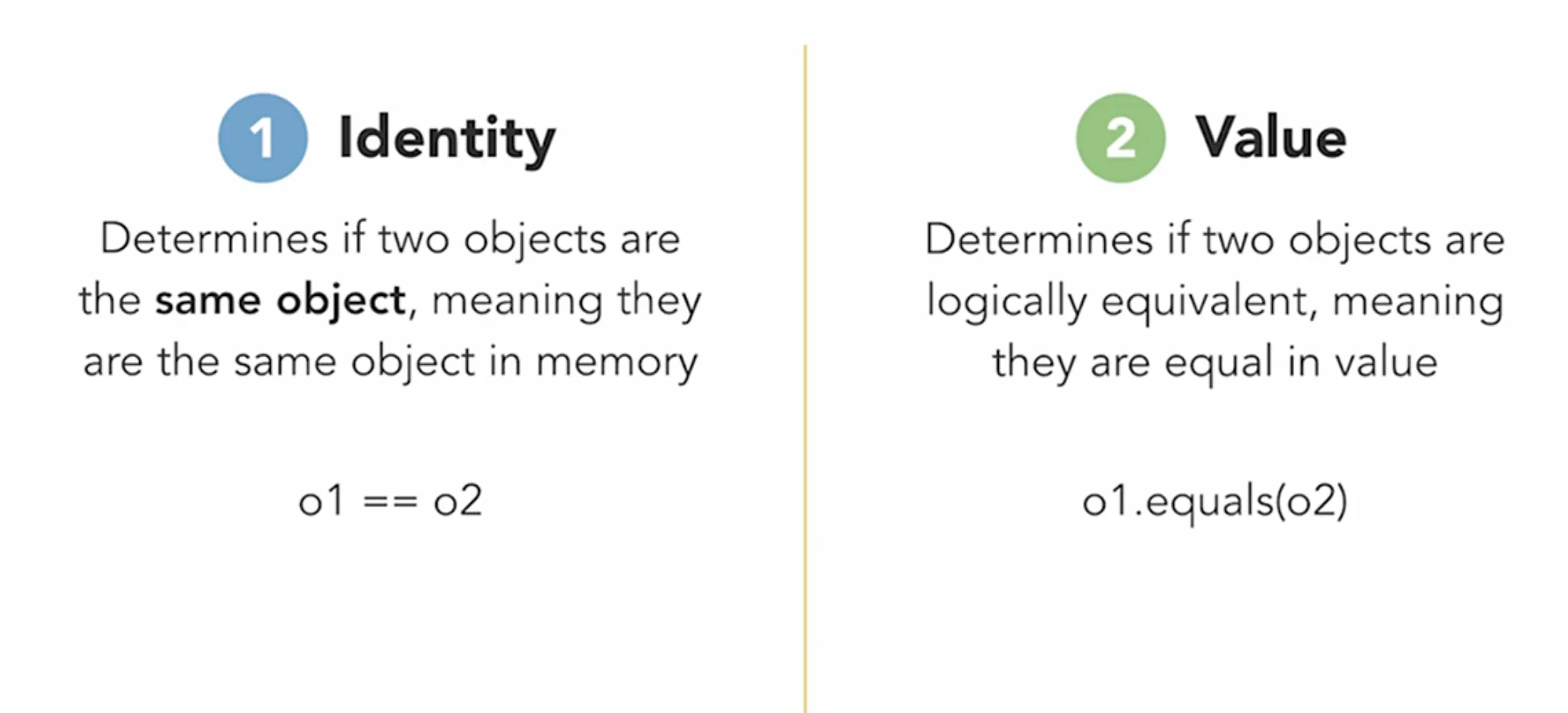
📊 Comparison Table
Section titled “📊 Comparison Table”| Feature | == Operator | equals() Method |
|---|---|---|
| Purpose | Compares references (memory addresses) | Compares content/data (logical equality) |
| Usage | Used for primitive types and object references | Used to compare the actual content of objects |
| Default Behavior | For objects, compares memory addresses | Default in Object class also compares memory addresses, but you can override it |
| Example (primitive) | int a = 5; int b = 5; a == b → true | Not applicable for primitives |
| Example (object) | obj1 == obj2 → true if same memory | obj1.equals(obj2) → true if logically equal |
| Performance | Very fast (direct memory comparison) | Can be slower (may involve method calls) |
| Override | Cannot be overridden | Can be overridden for custom logic |
🔍 Basic Examples
Section titled “🔍 Basic Examples”Primitive Comparison
Section titled “Primitive Comparison”public class PrimitiveComparison { public static void main(String[] args) { int a = 5; int b = 5; int c = 10;
System.out.println(a == b); // true (same value) System.out.println(a == c); // false (different values)
// For primitives, == is the only way to compare double d1 = 3.14; double d2 = 3.14; System.out.println(d1 == d2); // true
// Floating point precision issues double d3 = 0.1 + 0.2; double d4 = 0.3; System.out.println(d3 == d4); // false! (0.30000000000000004 != 0.3) System.out.println(Math.abs(d3 - d4) < 0.0001); // true (use tolerance) }}Object Reference Comparison
Section titled “Object Reference Comparison”class Person { String name; int age;
Person(String name, int age) { this.name = name; this.age = age; }}
public class ObjectComparison { public static void main(String[] args) { Person p1 = new Person("Alice", 25); Person p2 = new Person("Alice", 25); Person p3 = p1; // Same reference
System.out.println(p1 == p2); // false → different objects System.out.println(p1 == p3); // true → same reference System.out.println(p1.equals(p2)); // false → not overridden, so still compares references
// String comparison String s1 = "Hello"; String s2 = "Hello"; String s3 = new String("Hello");
System.out.println(s1 == s2); // true → string pool System.out.println(s1 == s3); // false → different objects System.out.println(s1.equals(s3)); // true → content comparison }}🔧 Implementing Custom equals() Method
Section titled “🔧 Implementing Custom equals() Method”Now, if we override equals(), it becomes logical comparison:
class Person {    String name;    int age;
    Person(String name, int age) {        this.name = name;        this.age = age;    }
    @Override    public boolean equals(Object o) {        // Check if same reference        if (this == o) return true;
        // Check if null or different class        if (o == null || getClass() != o.getClass()) return false;
        // Cast and compare fields        Person person = (Person) o;        return age == person.age && Objects.equals(name, person.name);    }
    @Override    public int hashCode() {        return Objects.hash(name, age);    }
    @Override    public String toString() {        return "Person{name='" + name + "', age=" + age + "}";    }}
✅ Always override hashCode() when you override equals()
Section titled “✅ Always override hashCode() when you override equals()”If two objects are equal (according to .equals()), they must have the same hash code if used in hash-based collections like:
HashSetHashMapHashtableLinkedHashMapConcurrentHashMap
Example
Section titled “Example”@Overridepublic int hashCode() { return Objects.hash(name, age);}🔒 For immutable fields like
nameandage, this is safe and efficient.
🔥 What happens if you override equals() but not hashCode()?
Section titled “🔥 What happens if you override equals() but not hashCode()?”❌ Example of Faulty Behavior
public class HashCodeExample {    public static void main(String[] args) {        Person p1 = new Person("Alice", 25);        Person p2 = new Person("Alice", 25);
        System.out.println("p1.equals(p2): " + p1.equals(p2));  // true
        Set<Person> set = new HashSet<>();        set.add(p1);        set.add(p2); // Should NOT be added if equals() says they are same
        System.out.println("Set size: " + set.size());  // Prints 2! (should be 1)        System.out.println("p1.hashCode(): " + p1.hashCode());        System.out.println("p2.hashCode(): " + p2.hashCode());  // Different hash codes!    }}
🔑 Key Takeaway:
Section titled “🔑 Key Takeaway:”Contract:
Ifa.equals(b)istrue, thena.hashCode() == b.hashCode()must also be true.