
API Design Guidelines
APIs (Application Programming Interfaces) form the connective tissue of modern software architectures. A well-designed API acts as a clear, predictable contract between different systems, frontend clients, and third-party developers.
Poorly designed APIs lead to integration nightmares, security vulnerabilities, and brittle systems that break with every update. This guide covers the enterprise standards for building robust RESTful APIs.
1. Principles of RESTful Design
Section titled “1. Principles of RESTful Design”REST (Representational State Transfer) is an architectural style based on standard HTTP concepts.
Core Concepts
Section titled “Core Concepts”| Principle | Description | Example |
|---|---|---|
| Resource-Oriented | URLs represent nouns (resources), not actions (verbs). | ✅ GET /users❌ GET /getUsers |
| Statelessness | Every request must contain all info needed to process it. The server stores no session state. | Pass an Auth token with every request. |
| Idempotency | Performing a request multiple times yields the same state result. | PUT, DELETE, and GET are idempotent. POST is not. |
Standard HTTP Methods
Section titled “Standard HTTP Methods”GET: Retrieve data (Read-only, idempotent).POST: Create a new resource (Not idempotent).PUT: Completely replace an existing resource (Idempotent).PATCH: Partially update an existing resource.DELETE: Remove a resource (Idempotent).
2. API Lifecycle
Section titled “2. API Lifecycle”An API is a living product. Managing its lifecycle effectively ensures that consuming teams aren’t broken by sudden changes.
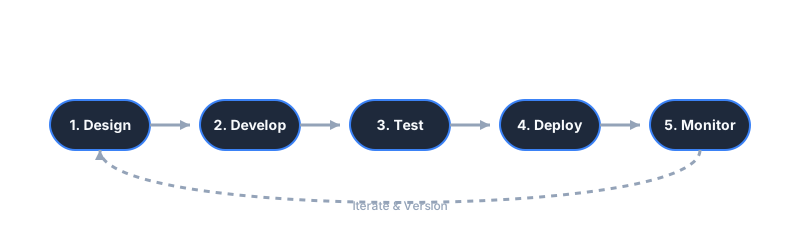 The continuous loop of API evolution.
- Design First: Define the contract using OpenAPI/Swagger before writing code. This allows frontend and backend teams to work in parallel.
- Develop & Test: Build to the contract. Write automated contract tests.
- Deploy & Monitor: Expose via an API Gateway. Track latency, error rates, and traffic spikes using tools like Grafana.
- Deprecate: When replacing an endpoint, communicate clearly, monitor usage of the old endpoint, and enforce a grace period before shutting it down.
3. The DTO Pattern (Data Transfer Objects)
Section titled “3. The DTO Pattern (Data Transfer Objects)”Never expose your raw database entities directly through your API. This tightly couples your database schema to your public API and often leads to accidental data leaks (like exposing password hashes).
Instead, use Data Transfer Objects (DTOs).
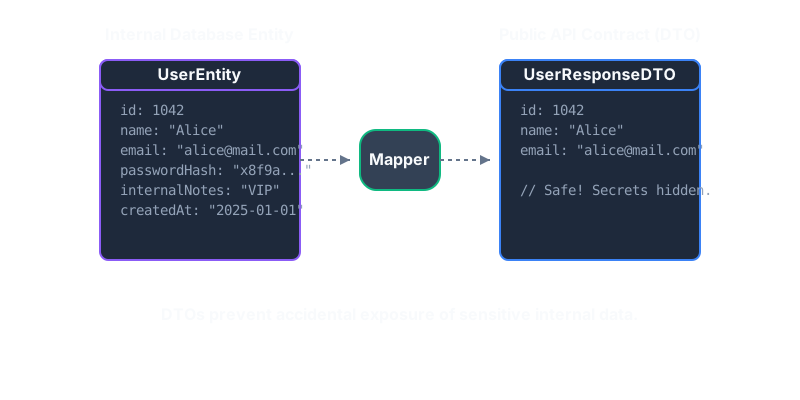 A Mapper layer translates internal Database Entities into safe, public-facing DTOs.
Best Practices for DTOs
Section titled “Best Practices for DTOs”- Separate Request/Response: Have different objects for incoming and outgoing data. A
UserCreateRequestdoesn’t need anid, but aUserResponsedoes. - Validation: Enforce validation rules directly on the Request DTOs (e.g.,
@Email,@NotNullannotations).
// Incoming Request DTO (Minimal){  "name": "Alice",  "email": "alice@example.com"}
// Outgoing Response DTO (Rich, safe){  "id": "usr_98x2y",  "name": "Alice",  "email": "alice@example.com",  "createdAt": "2025-10-07T10:00Z"}
4. Error Handling
Section titled “4. Error Handling”A good API tells the developer exactly what went wrong and how to fix it. Return standardized error payloads and correct HTTP status codes.
Standard Error Payload
Section titled “Standard Error Payload”{ "status": 400, "error": "Bad Request", "message": "Field 'email' must be a valid email address.", "path": "/api/users", "timestamp": "2025-07-29T10:23:00Z"}Essential Status Codes
Section titled “Essential Status Codes”| Code | Status | When to Use |
|---|---|---|
| 200 | OK | Successful GET, PUT, or PATCH. |
| 201 | Created | Successful POST (A new resource was made). |
| 400 | Bad Request | Client sent invalid data (failed validation). |
| 401 | Unauthorized | Missing or invalid authentication token. |
| 403 | Forbidden | Token is valid, but user lacks permission to do this. |
| 404 | Not Found | The requested resource ID does not exist. |
| 500 | Internal Error | Server crashed. Never expose stack traces here! |
5. Versioning APIs
Section titled “5. Versioning APIs”Because an API is a contract, changing the structure of a response is a “Breaking Change.” You must version your APIs to let older clients continue functioning.
Strategies:
- URI Versioning (Most Common):
https://api.myapp.com/v1/users - Header Versioning: Pass
X-API-Version: 2in the request headers. Keep URLs perfectly clean.
6. Optimization and Security
Section titled “6. Optimization and Security”Enterprise APIs must handle scale and defend against malicious actors.
Filtering, Sorting, and Pagination
Section titled “Filtering, Sorting, and Pagination”Never return a massive database table in one request. Force clients to use pagination.
GET /api/users?status=active&sort=createdAt&order=desc&page=2&limit=50Security & Rate Limiting
Section titled “Security & Rate Limiting”- HTTPS Everywhere: All API traffic must be encrypted via TLS.
- Authentication: Use industry standards like OAuth 2.0 or JWT (JSON Web Tokens).
- No Secrets in URLs: Never pass API keys or passwords in the URL query parameters. They will be saved in server access logs. Put them in Headers.
- Rate Limiting (429 Too Many Requests): Implement API Gateways to throttle users making excessive requests to prevent DDoS attacks and database exhaustion. Return a
Retry-Afterheader telling the client when to try again.